Social Media for Churches: Why Your Posts May Be Falling Flat (and How to Fix It)

Managing your church’s social media account can feel like shouting into a void.
You plan content. Post regularly.
And still end up with low engagement.
If your church’s social media content isn’t connecting the way you hoped, the problem might not be your effort but your approach.
Most social media how-to articles give the same advice:
- Post often
- Stay consistent
- Repeat
But posting more doesn’t necessarily build connection — creating social media content that resonates does. And it’s easier than most churches realize.
Why isn’t my church’s social media content getting more engagement?
Many church social media accounts are set up to broadcast rather than converse.
When your church’s social media feed becomes a bulletin board, people stop paying attention. Announcements and event reminders have their place, but they don’t give anyone a reason to stop scrolling.
And once engagement drops, algorithms make it even harder: Low-performing posts get shown to fewer people — even those already following you.
The fix isn’t posting more.
It’s posting content that invites a response and continues the conversation.
Here’s what this looks like practically:
A member comments on your sermon post — “This encouraged me. Going through it with my dad’s diagnosis.”
Your church’s social media account responds by “hearting” the comment. End of conversation.
Now, imagine if you replied: “We’re praying for you. Pastor Mike would love to connect — DM us.”
That’s not social media management. That’s pastoral care happening beyond the pulpit, right where your members are.
This is exactly why your pastor’s personal profile can help your church social media strategy.
Personal accounts consistently outperform ministry pages because social media algorithms favor people over organizations.
And research on how people respond to algorithmic content suggests that human trust is the most important factor.
Your congregation already looks to your pastor for guidance on Sunday — the rest of the week should be no different.
A short video, a personal reflection, a behind-the-scenes moment from the week: None of these are heavy lifts.
The goal isn’t for your pastor to become a content creator. It’s for them to show up online the way they already show up in person.
And your church’s social media account doesn’t have to watch from the sidelines either.
When you reshare or engage with the pastor’s post, it signals to the algorithm that the content is worth amplifying, extending its reach even further.
What does good church social media content look like?
Most church social media strategies lack direction.
Scroll through a typical feed, and you’ll find a little of everything: Announcements, sermon clips, Bible verses, event promos, and giving reminders.
When your church’s social media account tries to post everything to reach everyone, it usually resonates with no one.
The churches with the strongest engagement have decided what their account is actually for.
The best church social media posts have a few things in common:
- They’re community-focused — not organization-focused. Instead of highlighting what the church is doing, they highlight the people. A post that says, “Miss Carol has volunteered at our food pantry every Saturday for three years,” is more powerful than “Join us for our food pantry ministry.”
- They invite interaction. A simple prompt like “Tag someone in our church who has made a difference in your life” can pull more people into conversation than a week’s worth of announcements.
- They tell stories. A two-minute video of someone sharing how they found community during the hardest year of their life will outperform a graphic promoting small group sign-ups every time. Stories build trust in a way that announcements never can.
4 examples of church social media posts that work
These posts from real churches show what engaging church social media content actually looks like.
The posts aren’t about what the church did — they’re about impact. This subtle shift is what turns a social post into something meaningful that resonates with your members.
1. The milestone moment
When the AIM Ministries secured their first bus for their outreach program, they brought their community along for the ride.
Why it works: The story isn’t “we got a bus.” It’s “now we can reach more people who need us.” Followers feel like they’re part of the journey — not just informed about it.

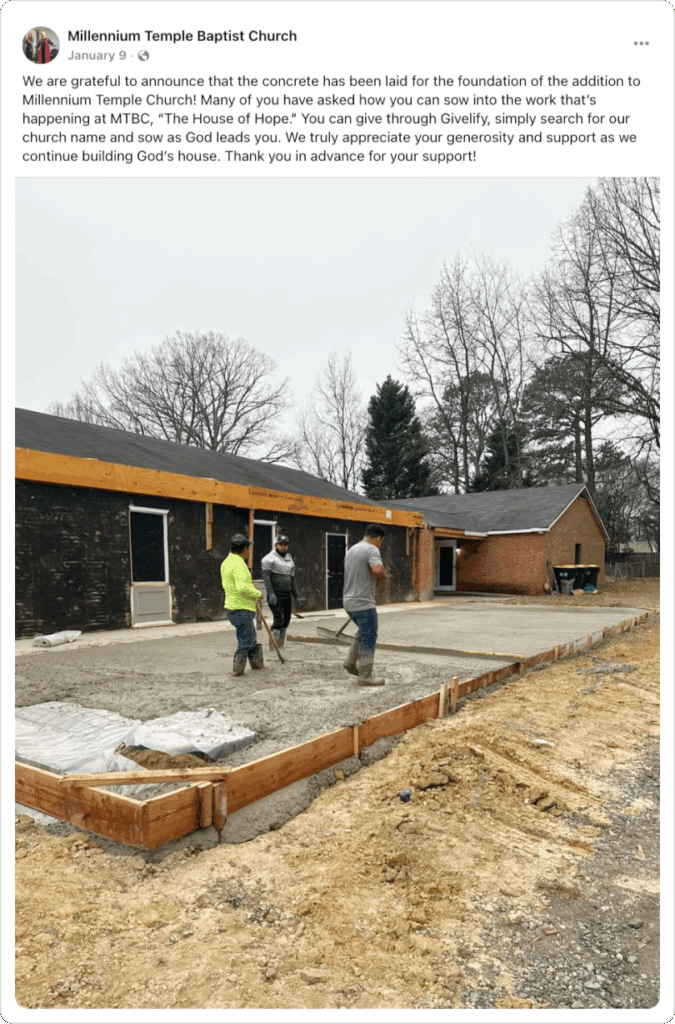
2. The visible progress update
Millennium Temple shared a photo of workers laying the foundation for their new building addition, “The House of Hope.”
Why it works: Showing your members what their generosity built — in real time — is far more motivating than a general update.
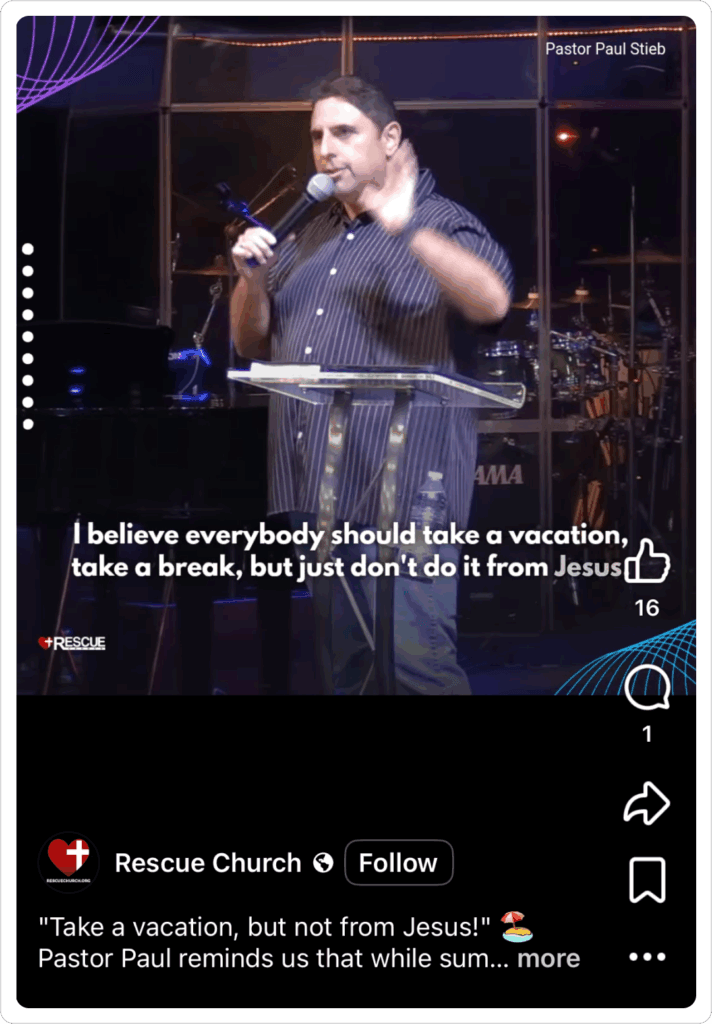
3. The sermon clip
Rescue Church knew their congregation was heading into summer, and met them there. A short video of their pastor paired with the caption “Take a vacation, but not from Jesus!” turned a seasonal moment into a reason to stay engaged.
Why it works: It’s timely, quotable, and speaks to something people are actually experiencing. That kind of relevance is what drives real engagement.
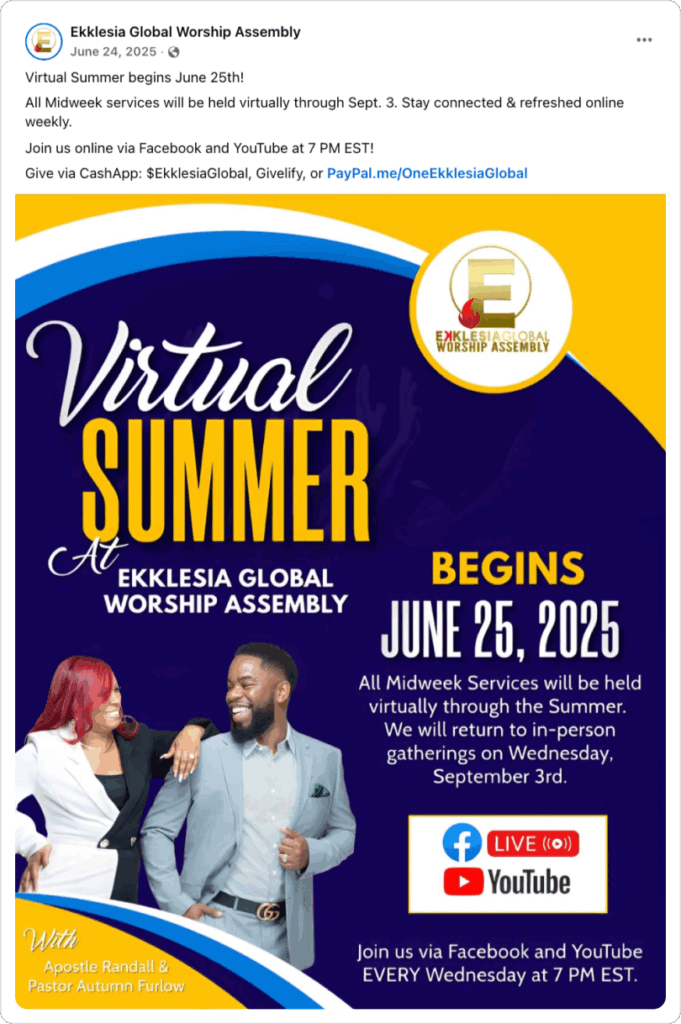
4. The virtual connection post
Before summer schedules pulled people away, Ekklesia Global announced a “Virtual Summer” — moving all midweek services online through September so no one had to choose between their routine and their faith community.
Why it works: Summer scatters people — from vacations to shifting routines. Ekklesia got ahead of it and made staying connected the path of least resistance.
Church social media post ideas you can try this week
- Ask a question. Post one open-ended question and invite your congregation to respond. It can be faith-related, community-focused, or even lighthearted.
- Share a story. Think of one person whose life has been impacted by your ministry. Ask if you can share their photo and a few sentences about their journey. One story can outperform a week of announcements.
- Use video intentionally. You don’t need production quality. A 30- to 60-second phone video of your pastor talking directly to your congregation connects in a way that text and graphics can’t.
- Highlight people — not just events. Before posting about an upcoming event, ask: “Is there a person or story connected to this that I could share instead?”
- Vary your content mix. For every announcement or promotional post, aim for two or three posts that are purely about connection, inspiration, or community.
- Reply to every comment this week. Not just with a reaction, but with a real response. You may be surprised by what opens up.
- Encourage a ministry leader to post a personal reflection this week. It doesn’t have to be polished. It just has to be them.
Turn church social media engagement into generosity
Connection and generosity go hand in hand.
When people feel seen and engaged, giving becomes a natural expression of faith and belonging, rather than a transaction.
If you’re thinking about how to naturally weave generosity into your church’s social media content, watch this short video from a fellow pastor and Givelify team member.
About the Author