Do Political Donations Impact Church Giving? Here’s What New Research Shows.

If your phone has been buzzing with campaign texts and your mailbox is full of election ads, you’re not alone. Political advertising for the 2026 midterm elections is projected to reach a record $11.6 billion, up from $8.9 billion in 2022.
And the stakes feel high. In a Pew survey conducted in early October, the majority of voters said it “really matters” which party wins Congress.
As political campaigns attract more attention and donations, an important question emerges: Does increased political giving change how people support their churches and other causes they care about? The answer may not be what you would expect.
What research reveals about political and faith-based giving
When it comes to whether political donations impact charitable giving, previous research offers mixed findings. One study of Red Cross donors found that more political advertising led to a decrease in donations. But other research found no decline in charitable giving during election years.
People who donate to political campaigns often give to charitable causes, too. However, political giving is also far less common than charitable giving. In 2020, about 46% of U.S. adults donated to charity, compared to about 15% who reported making political donations in 2016. And during the 2024 election cycle, about 1.3% of people gave $200 or more to political campaigns.
Research focused specifically on faith-based giving is more limited. One study found that a presidential campaign stop was associated with a roughly 2% increase in Catholic parish collections for one week.
But questions remain about how political activity relates to congregational giving more broadly. Does increased political giving mean less giving to faith-based organizations?
To explore this question, Givelify partnered with Texas A&M University economics professors Marco Castillo, PhD, and Ragan Petrie, PhD, to examine the relationship between political contributions and faith-based giving.
How political donations impact faith-based giving
The analysis looked at giving patterns during the 2022 and 2024 election cycles to answer two key questions:
- Do close political races affect how much people give to their congregations?
- When people in a community give more to political campaigns, does faith-based giving decrease?
The findings suggest that faith-based giving remains remarkably resilient, even during periods of heightened political activity.
Church giving remains steady in close races
During the 2022 and 2024 election cycles, researchers compared giving patterns in congressional districts with close races to those where one candidate had a clear advantage. With political activity often intensifying in close races, this might be where a noticeable difference emerges.
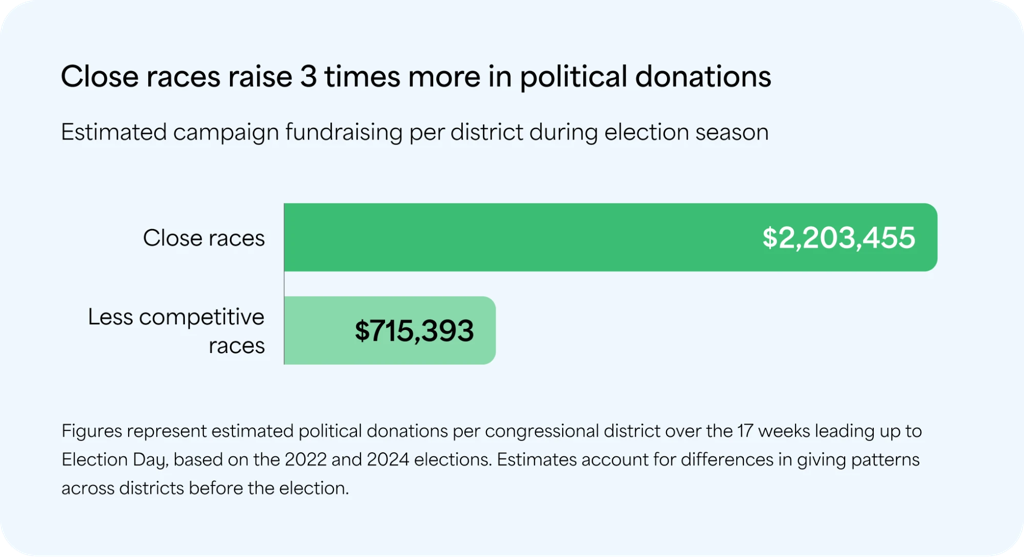
The difference in campaign fundraising was significant. In the weeks before Election Day, candidates in close House races raised about $250,000 more per district, per week, compared with roughly $32,000 in districts with less competitive races — about nine times as much.
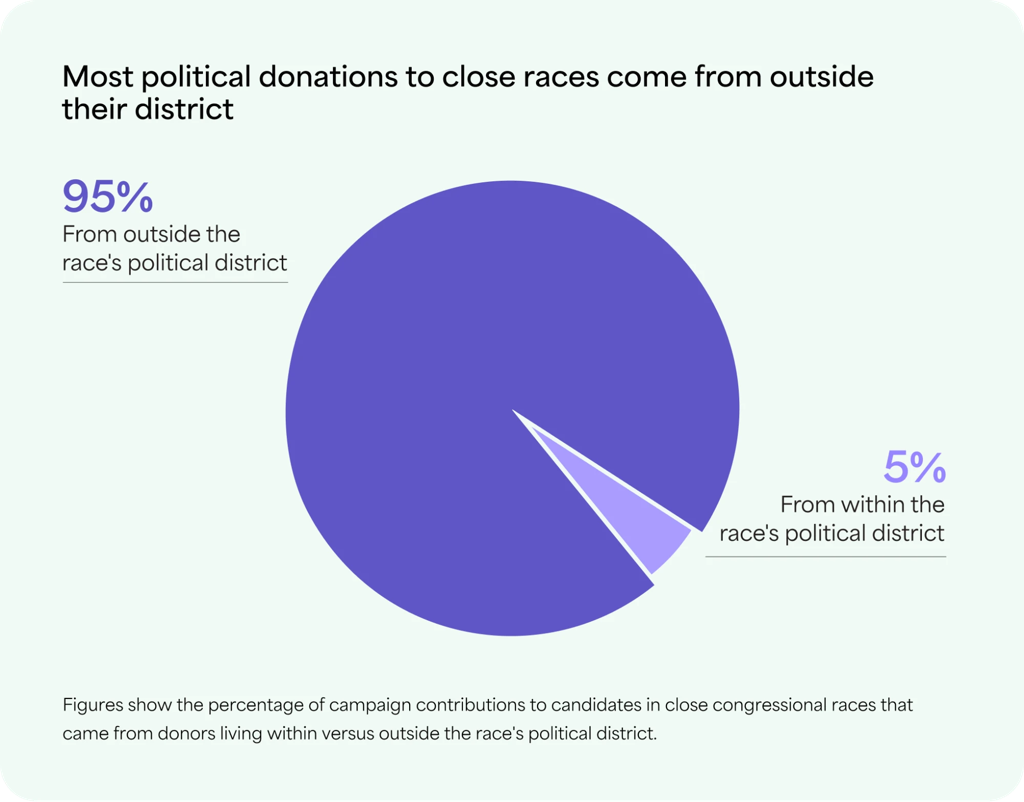
But here’s what’s interesting: Most of those additional campaign funds came from outside the district. Residents of districts with close races didn’t give more to political campaigns.
Faith-based giving also remained steady. In districts with close races, people gave about the same amount to their congregations each week as those in less competitive districts.
A typical weekly donation is about $22 per donor. The difference in giving between those in close races and those in less competitive races was around one dollar per donor each week, both before and after Election Day — a nominal amount.
Rises in political donations, small changes in church giving
Next, researchers compared weeks when people gave more to political campaigns with weeks when they gave less, within the same zip code.
The impact on faith-based giving was marginal. In weeks when campaign giving was higher, faith-based giving was slightly lower. For every additional $100 donated to political campaigns, faith-based giving was about 27 cents lower. The equivalent of about a quarter. Of those 27 cents, about 15 came from tithes and about 12 from other gifts.
In other words, if people in a zip code gave $1,000 more to political campaigns in a week, faith-based giving would be about $2.70 lower.
This pattern was consistent across denominations, genders, areas with different political leanings, and income levels. In every case, the impact on faith-based giving remained small.
One word of caution: These findings reveal patterns, not causation. They do not show that political giving causes faith-based giving to decrease.
What this means for faith leaders
Why might faith-based giving hold steady during election seasons? While the research cannot determine the exact reasons, faith, habit, and a sense of belonging may help explain why.
For many congregations, giving is deeply connected to faith. In a Lifeway survey, more than eight in 10 Baptist, Pentecostal, nondenominational, and African American churchgoers said tithing is a biblical command that still applies today. About half of regular Protestant churchgoers reported giving a tenth or more of their income to their church.
While these factors may help explain the findings, the analysis doesn’t establish why faith-based giving remained resilient.
So, what can faith leaders take away from this research?
- Election season is loud, but it doesn’t mean less church giving. Even in districts with close political races and during weeks of increased campaign donations, faith-based giving remained relatively stable. Political activity doesn’t necessarily mean a decline in congregational giving.
- Continue nurturing generosity through faith and connection. Giving behaves less like a line item in a budget and more like an expression of faith. While this research doesn’t establish what motivates giving during election seasons, this may help explain why congregational giving remains steady.
- Stay focused on what matters most. While elections may compete for attention, the heart of ministry remains the same: building relationships. Continue to strengthen connections with your congregation by thanking them for their generosity, showing how their gifts make a difference, and making giving easy. These are valuable practices in any season, even though they weren’t directly evaluated in this research.
Faith-based giving remains resilient
Campaign seasons come and go, but the findings suggest that congregational giving doesn’t necessarily follow the political news cycle.
For faith leaders, that’s an encouraging reminder of the role faith and community play in sustaining generosity, even during periods of heightened political activity.
About the research
Givelify partnered with Texas A&M University economics professors Marco Castillo, PhD, and Ragan Petrie, PhD, to examine the relationship between political contributions and faith-based giving.
The analysis combined two sources: Givelify donation data from congregations and publicly available political contribution records from the Database on Ideology, Money in Politics, and Elections (DIME), which generally includes reported contributions of $200 or more.
Researchers examined giving patterns during the 2022 and 2024 election cycles, using other years for comparison. The analysis explored two relationships:
- Competitive political races: Researchers compared campaign contributions and faith-based giving in congressional districts with close races and those with less competitive races.
- Local political giving: Researchers compared weekly political contributions and faith-based donations within zip codes, accounting for typical giving patterns and election-year trends.
All data were analyzed by geographic area, without identifying individual donors.
The findings reveal patterns in giving behavior but do not establish that political contributions directly cause changes in faith-based giving.
Contributors
Marco Castillo, PhD, Economist, Texas A&M University
Marco is an economist who uses experimental methods to identify optimal policy design and interventions in areas ranging from crime, human capital accumulation, to charitable fundraising. He is a Professor of Economics at Texas A&M University.
Ragan Petrie, PhD, Economist, Texas A&M University
Ragan is an economist who uses behavioral and experimental approaches to study motives for charitable giving, gender differences in bargaining and competition, discrimination, social media and the economic preferences of children. She is a Professor of Economics at Texas A&M University.
AJ Mafolasire, M.D., Head of Data Science & Philanthropic Research, Givelify
AJ is a data scientist with nearly two decades of data science and research experience who leads the vision and strategy for advanced analytics tools and systems at Givelify. He holds a Doctor of Medicine degree from Yale University School of Medicine and earned a Master’s in Mechanical Engineering from Purdue University, as well as a Master of Health Science from Yale University School of Medicine.
About the Author