Menu

Close

Chapter 5 • 2026 GIVING IN FAITH REPORT
Introducing Faith-Based Donor Profiles
Donor motivations and giving behaviors vary more than many churches realize. This chapter identifies four distinct faith-based donor profiles and how each may shape consistent giving in your congregation.
Group of people standing close together smiling in casual attire, holding notebooks and a tablet, representing the four different faith-based donor profilesGroup of people standing close together smiling in casual attire, holding a tablet, representing the four different faith-based donor profilesGroup of people standing close together smiling in casual attire, holding notebooks and a tablet, representing the four different faith-based donor profiles

Key takeaways

  • Faith-based donors are not all the same, and treating them the same can limit how churches support generosity.
  • Four donor profiles emerged reflecting different motivations, beliefs, and giving habits: Devoted, Steady, Awakening, and Unengaged.
  • Different donors need different kinds of support to grow in generosity and consistent giving.

How this applies to faith leaders

  • Reflect on the different donor profiles within your church to better support generosity and spiritual growth.
  • Support donors at every stage of their generosity journey and the spiritual fulfillment they seek through giving.
  • Identify and address barriers that may prevent willing donors from building lasting and meaningful giving habits.
Faith-based donors are not a uniform group, and treating them as a monolith limits how generosity is understood and cultivated.

In this chapter, we define four distinct profiles of faith-based donors, offering a new perspective on how generosity varies across motivations, behaviors, and aspirations. These profiles highlight meaningful differences in how individuals engage with giving and offer practical insight into how churches can more effectively engage and support generosity.

Faith-based donors are not well understood

Much of the philanthropy literature groups faith-based donors with broader nonprofit givers. However, faith-based donors differ from nonprofit givers in how they give to their church and report different behaviors, motivations, and strategies when they give to other causes or nonprofits.
For example, in the 2024 Giving in Faith report, most faith-based donors (59%) reported setting aside a defined amount or percentage of their income to give to their place of worship (e.g., tithe, zakat). In contrast, when giving to causes or organizations outside of their places of worship, donors are more likely to give spontaneously (55%) or report having no real strategy (21%).[2]
While existing studies may categorize individuals by religious behavior[43] or by general giving approach,[44] research that specifically examines the characteristics of faith-based donors remains limited. As a result, their distinct motivations and behaviors are often underrepresented in the broader literature.
This gap has practical implications. Church leaders may find that guidance drawn from general philanthropy research does not translate effectively to church contexts, where giving is shaped by different expectations, beliefs, and patterns.
In this chapter, we define four distinct profiles of faith-based donors to address this gap and provide a clearer understanding of how giving behaviors, motivations, and aspirations vary across this population.  

Categorizing faith-based donors

We categorized faith-based donors based on how they describe their current pattern of giving to their churches in our survey. This structure provides the foundation for the four donor profiles introduced in this chapter and offers a clearer view of how donors see their own giving behavior.
Most surveyed donors (76%) already consider themselves to be consistent givers, though many still aspire to give even more consistently. Nearly half (49%) identify as consistent givers who want to be even more consistent, while 27% report being satisfied with their current level of giving. Among the remaining donors, 21% say they are not yet consistent but aspire to be, and 4% neither give consistently nor express a desire to do so.
Chart showing four faith-based donor profiles based on consistency and motivation: Devoted, Steady, Awakening, and Unengaged.
We then examined how donors in each of these categories differ in their religious and demographic characteristics, as well as in their motivations for giving.  
To assess differences in religiosity, we developed a composite religiosity score based on self-reported behaviors and beliefs.
  • Religiosity
    Higher scores reflect more frequent religious engagement and stronger self-identification as a religious or spiritual person
To better understand these motivations, we conducted a factor analysis on giving-related attitudes, which revealed four core drivers of generosity:
  • Giving with faith
    The role of giving in growing or strengthening their faith, linking generosity to spiritual growth, maturity, and the donor's relationship with God
  • Trust in church
    Trust in their church and perceived impact of giving, capturing donors' confidence that their contributions are being used responsibly and make a difference Importance of impact
  • Importance of impact
    The personal importance of impact and appreciation, which captures how much donors value knowing their effect and feeling appreciated for their generosity
  • Positive emotions
    Feelings of warm glow, fulfillment, and appreciation, which describe the extent to which giving produces positive emotional experiences for the donor
Additional details on the religiosity and motivational measures are provided in the Methodology section.

Four profiles of faith-based donors emerged

Based on donors’ motivations, behaviors, and self-reported consistency, we define four distinct profiles of faith-based donors:

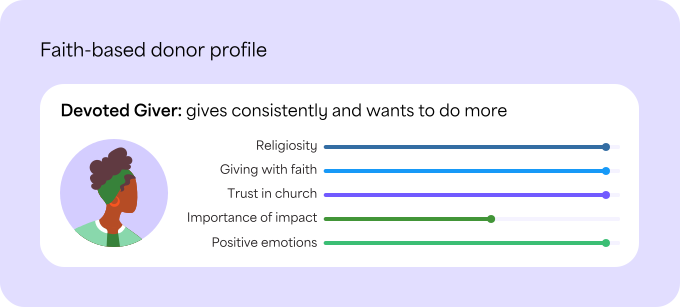
The Devoted Giver

Faith-based donor profile card of the Devoted Giver who gives consistently and wants to give more
The Devoted Giver gives consistently to their churches and continues to aspire to give even more. Already the most religiously engaged donors in this study, they are significantly more likely than other profiles to view giving as both an expression of and a pathway to strengthening their faith.
They are the most likely to believe in tithing, report a higher proportion of their giving in the form of tithes, and define consistent giving according to faith teachings. Devoted Givers also report the highest levels of trust in how their church uses their giving and confidence in the impact of their contributions, as well as pronounced feelings of warm glow, fulfillment, and appreciation when they give.
Demographically, Devoted Givers tend to be older than Awakening Givers and are similar in median age to Steady Givers.

The Steady Giver

Faith-based donor profile card of the Steady Giver who gives consistently and is satisfied
The Steady Giver gives consistently and is satisfied with their current level of giving. Unlike the Devoted Giver, they are not seeking to increase their consistency.
Along with the Awakening Giver, they are less likely than the Devoted Giver to report feelings of warm glow, fulfillment, and feelings of appreciation when they give. Compared with the Awakening Giver, they give a significantly greater proportion of their gifts in the form of tithes, but less than Devoted Givers. The Steady Giver, compared with both Devoted and Awakening Givers, scores significantly lower on the factor tying their giving to spiritual growth.
A closer examination shows that, compared with Devoted and Awakening Givers, Steady Givers are significantly less likely to believe that consistent giving supports spiritual growth, that giving is an act of worship and gratitude, and that consistent giving leads to long-term blessings.
Demographically, the Steady Giver tends to have the highest levels of education and income, and they are more likely to be men.

The Awakening Giver

Faith-based donor profile card of the Awakening Giver who wants to give consistently but isn’t there yet
The Awakening Giver aspires to give consistently, but they have not yet achieved that pattern. While the intent is present, they often face financial difficulties that limit their ability to give more consistently.
Compared with Devoted or Steady Givers, the Awakening Giver is more likely to identify financial constraints as a primary barrier to consistency. They are also more likely to believe that economic conditions or their finances will negatively affect their ability to give. Compared with Devoted and Steady Givers, they give a significantly greater proportion of their donations in the form of offerings or non-tithe gifts. Demographically, the Awakening Giver tends to be younger, have less stable employment, and report lower household incomes.

The Unengaged Giver

Faith-based donor profile card of the Devoted Giver who does not give consistently or aspire to yet
The Unengaged Giver neither gives consistently nor aspires to do so yet. Because they represent only 4% of the sample, findings for this group do not reach statistical significance and should be interpreted with caution.
Even so, their patterns are distinct. Compared with other profiles, the Unengaged Giver scores the lowest on measures of religiosity, trust in churches, and feelings of warm glow or impact when they do give. They are also the least likely to believe in tithing.

Different donor profiles require different approaches

Summary of four faith-based donor profiles: Devoted, Steady, Awakening, and Unengaged.
These four profiles illustrate that faith-based donors are not a monolith. Each group reflects a distinct combination of motivations, behaviors, and constraints, suggesting that a one-size-fits-all approach to generosity discipleship is unlikely to be effective.  
  • Devoted Givers may benefit from occasional encouragement to deepen their existing practices.
  • Steady Givers may respond to new challenges or expanded goals.
  • Awakening Givers may need practical support to navigate financial barriers.
  • Unengaged Givers may require a different starting point, perhaps one focused on engagement before giving.
Understanding these differences is essential, but it’s only part of the story. The next step is to understand how consistent giving habits are formed and sustained.  
In Chapter 6, we introduce the Consistent Giving Model™, a novel framework grounded in multidisciplinary research and the specific motivations of faith-based donors, to explain how giving habits develop over time.