Menu

Close

Chapter 1 • 2026 GIVING IN FAITH REPORT
Introduction: The Unrealized Potential of Consistent Giving
U.S. faith communities may be missing out on $30B in annual faith-based giving. This chapter introduces why consistent giving matters and how churches can better understand, support, and strengthen generosity over time.
Male church leader and pastor in black robe reading from an open Bible during a church service.Male church leader and pastor in black robe reading from an open Bible during a church service.Male church leader and pastor in black robe reading from an open Bible during a church service.

Key takeaways

  • Most faith-based donors want to give more consistently, but intention doesn't always lead to action.
  • Modest improvements in giving consistency could help churches strengthen ministries and expand community impact.
  • Churches have an opportunity to rethink generosity through the lens of consistent giving.  

How this applies to faith leaders

  • Understand why many faith-based donors struggle to sustain consistent giving habits over time, even when they aspire to give more regularly.
  • Evaluate how the consistency shortfall may be affecting your congregation’s long-term financial stability and ministry capacity.
  • Apply the report’s research and frameworks to better understand donor behavior and strengthen consistent generosity across your congregation.

Executive summary 

Faith communities across the United States may face as much as $30 billion in unrealized giving each year. This report identifies this invisible financial gap as the consistency shortfall: the unrealized potential created when faith-based donors are unable to give as consistently as they intend and when church leaders overestimate the rate of consistent giving within their congregations. At its core, the consistency shortfall is not a problem of generosity, but of consistency. The challenge is not whether donors want to give, but the difficulty of understanding, supporting, and sustaining giving consistency over time.
Produced by Givelify Philanthropic Research & Insights, a research initiative of Givelify, with support from the Lake Institute on Faith & Giving, part of the Indiana University Lilly Family School of Philanthropy, the fourth edition of the Giving in Faith report examines this consistency shortfall through a deep analysis of the behavioral and motivational factors shaping consistent giving. At a time when congregations continue to navigate economic uncertainty, shifting patterns of religious participation, and growing community needs, understanding the factors that shape consistent generosity has become increasingly important.
The issue carries significant implications for congregations and the communities they serve. The religious charitable sector receives more than $150 billion annually.[1] Even modest increases in consistent giving, defined in this report as giving that occurs monthly for most months, could meaningfully expand what congregations are able to sustain within their communities. For a typical congregation with 65 attendees, greater giving consistency could translate into tens of thousands of additional contributions annually to support food pantries, shelter for the unhoused, tutoring programs, and other forms of community outreach.
The consistency shortfall also carries an important human dimension. Consistent donors account for more than 80% of annual congregational giving, yet they represent fewer than one in three faith-based donors. At the same time, most faith-based donors aspire to be even more generous,[2] and research consistently shows that those who give more tend to report higher levels of happiness and positive wellbeing.[3], [4] These findings suggest that many congregants are not giving as much or as often as they aspire to, meaning that reducing the consistency shortfall could benefit donors as much as it benefits congregations and communities.
Understanding why relatively few donors achieve their desired level of giving consistency, and how churches can better support them, requires a foundation that the field has not yet established: a shared operational definition of consistent giving.
Drawing on national survey research with church leaders and faith-based donors alongside analysis of transactional giving data from Givelify’s online and mobile giving platform, this report addresses that gap by defining, measuring, and examining consistent giving through the perspectives of faith-based donors, church leaders, and congregations. It also introduces a behavioral framework — informed by multidisciplinary research, survey findings, and observed giving behavior — for understanding how consistent generosity develops and is sustained over time within faith-based contexts.

The importance of consistent giving in faith-based communities

Over the past six years, the Giving in Faith surveys have tracked how places of worship and their attendees continued to overcome several major challenges, from embracing new digital tools during the COVID-19 pandemic shutdowns to navigating generational changes in religious giving and participation.
Since the 2024 report, various sources have reported that religious decline has begun to level off,[5] and religion continues to receive the most charitable donations among all major subsectors.[1] In 2025, however, the U.S. economy began to face new turbulence driven by tariffs,[6] layoffs,[7] government shutdowns,[8] and escalating geopolitical tensions.[9]
Despite the uncertain economic times, a recent analysis of Givelify’s transactional giving data by economists at Texas A&M University shows that the average donation amount to places of worship increased in 2025, though not enough to outpace inflation.[10] Even more encouraging is the finding that tithing (i.e., the religious practice of giving 10% of one’s income to their church or other faith-based organization) has grown about 3% annually, while non-tithe gifts have remained relatively flat.
This divergence suggests that consistency, not just generosity, may be the defining factor in sustained giving. Despite the importance of consistent giving to congregational health, surprisingly little is known about who consistent givers are, what drives their consistency, and what gets in the way. Part of the reason for this gap is that the field has yet to establish a shared, operational definition of what it means. At the conceptual level, consistent giving refers to a pattern of regular giving, but how it is defined varies across churches, donors, industries, and researchers.
Without a shared definition of consistent giving, researchers cannot compare findings across studies or build on each other’s work. Churches cannot meaningfully benchmark their congregation's giving against broader trends. Donors lack a clear understanding of what consistent generosity looks like or how to develop it over time, despite aspiring to be more generous. And the communities that depend on church outreach bear the cost of the gap between what congregations currently receive and what consistent generosity could enable.
This report addresses these gaps from the ground up. It begins by establishing an operational definition of consistent giving based on expectations and behaviors. It then applies this definition to illuminate the landscape of consistent giving among faith-based donors and their congregations. This exercise reveals a need to address the “consistency shortfall,” which is the financial implications of not addressing the gap between donors’ intent to give consistently and their actual giving behaviors and the overestimation of congregations’ consistent giving by church leaders.
The analysis explores the nuances among faith-based givers, including differences in motivations, aspirations, and giving patterns. Drawing on survey data and multidisciplinary research in faith-based philanthropy, the report also introduces a Consistent Giving Model that explains how faith-based donors develop and sustain habits of regular giving. Finally, it presents findings from a field experiment that demonstrates the model in practice.

How church leaders can engage with the Giving in Faith report

For those leading congregations, the 2026 Giving in Faith report offers insights at the intersection of discipleship and data. It examines a central question: What does it mean for a donor to give consistently, and how can more members be supported in developing this practice?
The following guidance outlines how to use this report:
CHAPTER 3
Build a shared foundation of consistent giving
Begin with Chapter 3 to understand the report’s definition of consistent giving. Because the term is used differently across churches, researchers, and platforms, this chapter establishes a common foundation for how consistency is defined and measured. Starting here ensures a shared frame of reference, making it easier to interpret the findings that follow and apply them with clarity and confidence within your congregation.
Chapter 4
Assess your congregation’s reality
Chapter 4 provides data on how consistently faith-based donors give and compares these patterns with church leaders’ perceptions. This section can serve as a benchmark, helping leaders evaluate how their congregation’s giving aligns with broader trends.
Chapter 5
Understand different types of givers
Chapter 5 identifies four distinct profiles of faith-based donors: Devoted, Steady, Awakening, and Unengaged Givers. Each group reflects different motivations, behaviors, and aspirations. This chapter explores how different donor profiles may be represented within congregations and what those differences suggest for cultivating generosity that reflects congregants’ unique motivations and aspirations.
Chapter 6
Explore what drives consistent giving
Chapter 6 presents the Consistent Giving ModelTM, outlining how donors develop and sustain habits of regular giving. This section highlights the key drivers behind consistent generosity and equips church leaders with actionable insights to actively build and sustain a culture of consistent giving within their congregation.
Chapter 7
See the Consistent Giving Model in practice
Chapter 7 presents a field experiment and analysis on recurring giving options that demonstrate how digital tools can support consistent giving behaviors. It explores how specific features aligned with giving motivations can influence donor outcomes and offers practical considerations for integrating technology into giving strategies.
Key considerations for church leaders:
The data describes patterns and tendencies, not prescriptions. Each congregation is unique, and the findings in this report are intended to support reflection and inform strategies that align with different congregational contexts.
It is our hope that this report provides a clearer picture of where faith-based giving stands today and a shared language for understanding the consistency shortfall — the potential generosity left on the table when faith-based donors are unable to give as consistently as they aspire and church leaders overestimate the true rate of consistent giving — along with its broader implications for congregations and the communities they serve.

How researchers can engage with the Giving in Faith report

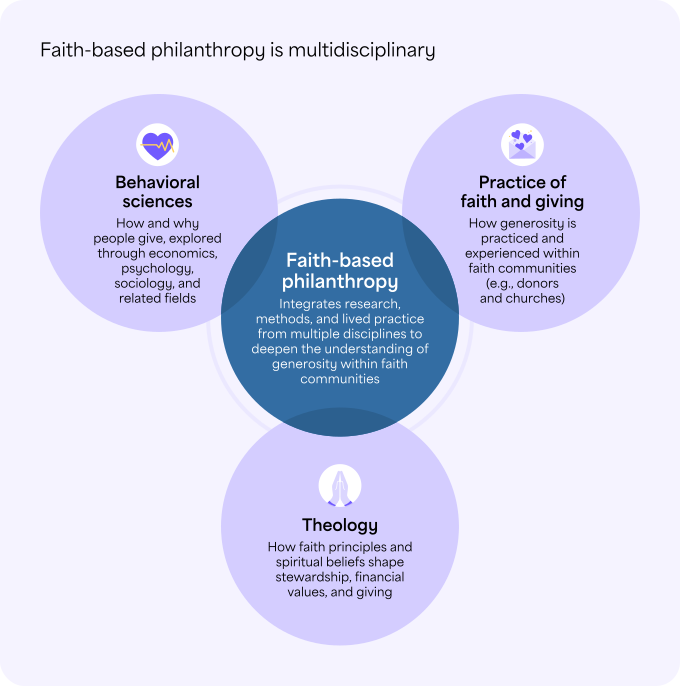
Faith-based philanthropy integrates behavioral sciences, theology, and faith and giving practices to understand generosity.
This report was also written with researchers in mind. Prior work in faith-based philanthropy has examined definitions of charitable giving, donor behavior, and motivations, but these elements have typically been studied in isolation without fully accounting for the role of religion. This report brings these components together by pairing an operational definition of consistent giving with a multidisciplinary approach to investigating faith-based donors’ beliefs, motivations, and behaviors.
It provides greater nuance in understanding faith-based donors by segmenting them into distinct profiles rather than treating them as a uniform group. Finally, it offers a theory-informed explanation of the giving process within a faith-based context, grounded in established models of behavior, such as the Theory of Planned Behavior.
To our knowledge, this report is among the first to define, measure, and explain consistent giving in faith-based contexts through a behavioral framework. By doing so, it aims to support more coherent measurement, enable comparability across studies, and provide a foundation for further exploration into the factors that shape consistent giving. The authors invite researchers and practitioners to test, refine, and extend the ideas and inquiries raised in this report.

Data and methodology

In early 2026, a survey was conducted among 894 Christian church leaders and 1,987 Christian faith-based donors across the United States.
As part of a separate planned analysis, we intentionally oversampled predominantly Black churches and Black Christian donors. The data presented in this report were subsequently weighted to reflect the religious landscape in the United States. Responses from church leaders were weighted to reflect U.S. demographics of Christian churches, using benchmarks from Lake Institute of Faith & Giving’s National Study of Congregations' Economic Practices[11] and the National Congregations Study,[12] respectively. Responses from Christian faith-based donors were weighted to match U.S. demographics of practicing Christians using benchmarks from Pew Research’s Religious Landscape Study.[13]
The report also draws on analyses of giving patterns from 1,719,069 donors who have contributed 60,549,332 donations totaling $7.2 billion to 47,506 churches through Givelify, an online and mobile giving platform used by churches across the United States.
Please see the Methodology section of this report for more information on the survey and data methodology.

About the respondents

Church leaders 

Of the 894 Christian church leaders surveyed, just under two-thirds (63%) identified as faith leaders in their congregations. The remaining third (37%) identified as church officials who are knowledgeable about their congregations’ finances (e.g., Chief Financial Officer, treasurer, bookkeeper).
Faith-based giving research: chart showing 63% of surveyed leaders are faith leaders and 37% are church financial officials.
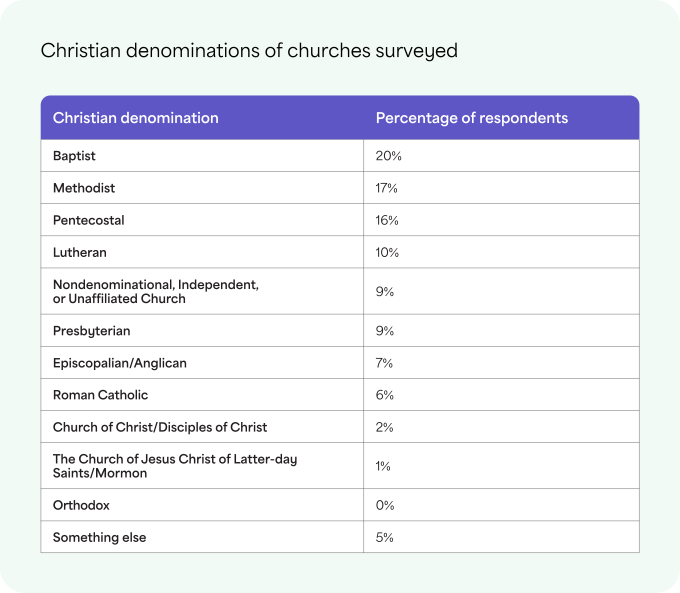
All church leaders report that the church they serve belongs to a Christian denomination. A wide range of denominations was represented in the survey, but the three most common were Baptist (20%), Methodist (17%), and Pentecostal (16%).
Christian denominations of churches surveyed

Faith-based donors

All 1,987 faith-based donors self-identified as practicing Christians who have made monetary donations to a place of worship in 2025.
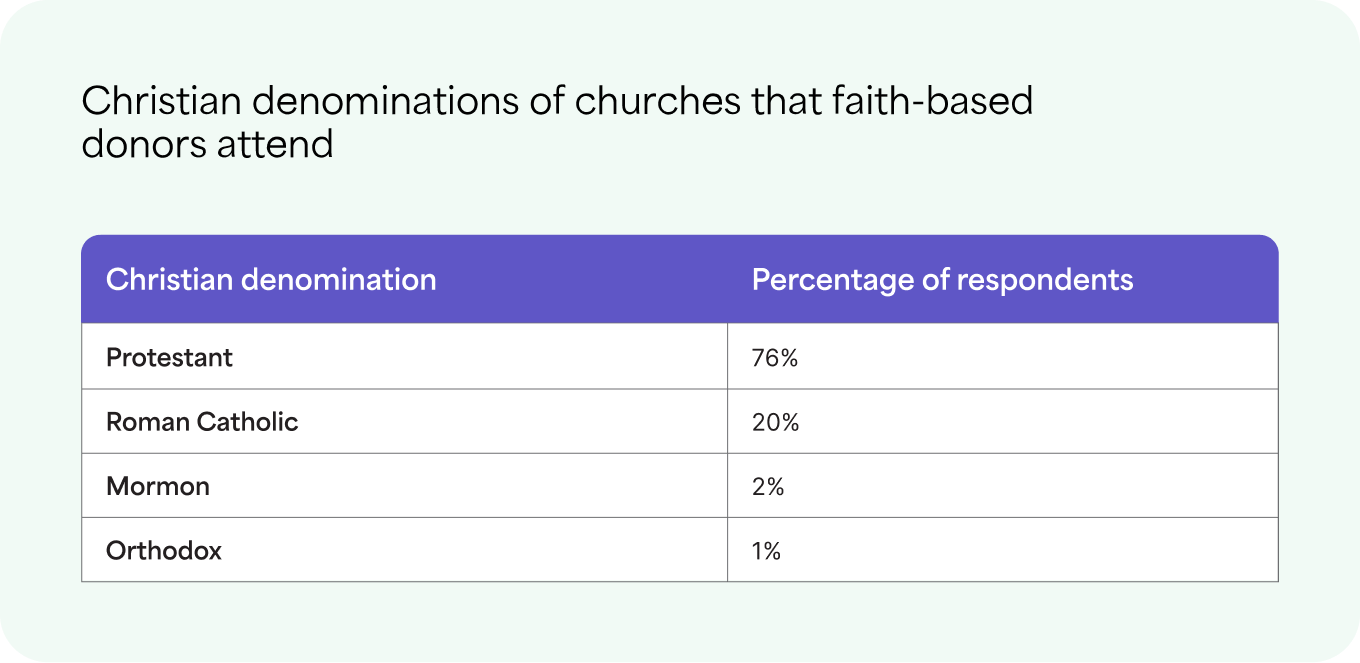
Most (76%) of the Christian faith-based donors attend a church belonging to a Protestant denomination. Fewer Christian faith-based donors identified as Roman Catholic (20%), Mormon (2%), or Orthodox (1%).
Christian denominations of churches that faith-based donors attend
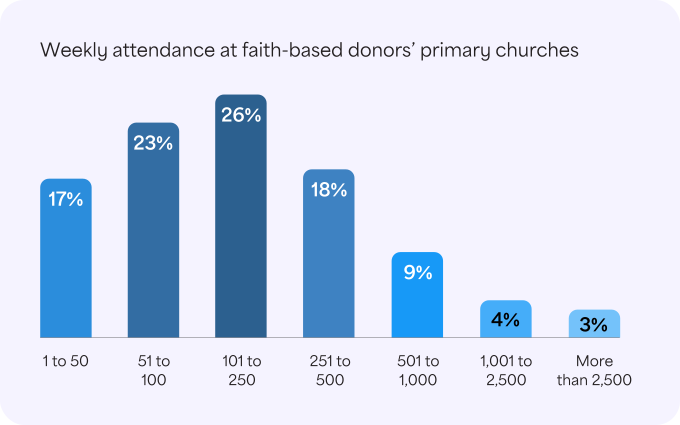
Although other studies find that most church attendees belong to large churches,14 faith-based donors in this survey primarily attend churches with fewer than 250 weekly attendees. Specifically, 40% of Christian donors attend a small church (100 or fewer attendees), 26% attend a medium-sized church (101 to 250 attendees), and 34% attend a large church (more than 250 attendees).
Chart showing 40% of faith-based donors attend small churches (100 or fewer attendees), 26% medium, and 34% large.
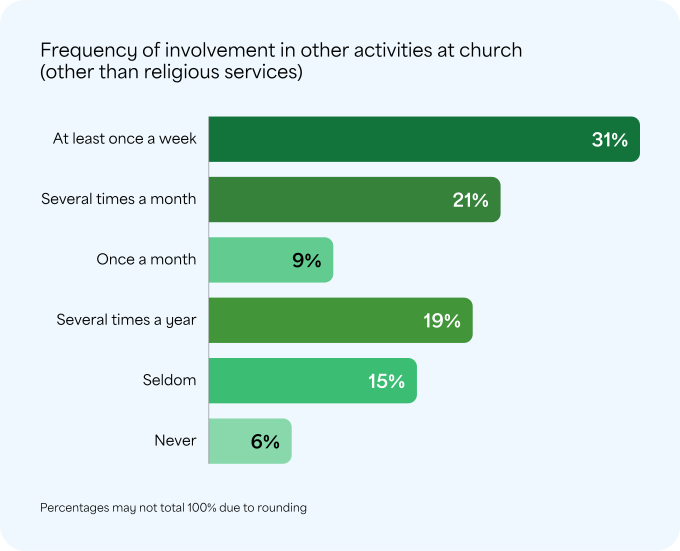
The Christian donors who responded to this survey tended to report high levels of both public and personal faith practices. Almost three-fourths of faith-based donors (73%) report attending religious services at least once a week. Additionally, 61% of faith-based donors take part in other activities at their church at least once a month. Together, these responses suggest that survey respondents skew toward more engaged churchgoers than a typical U.S. attendee.
Chart showing 73% of faith-based donors attend religious services at least once a week.
Chart showing 61% of faith-based donors participate in church activities at least once a month.
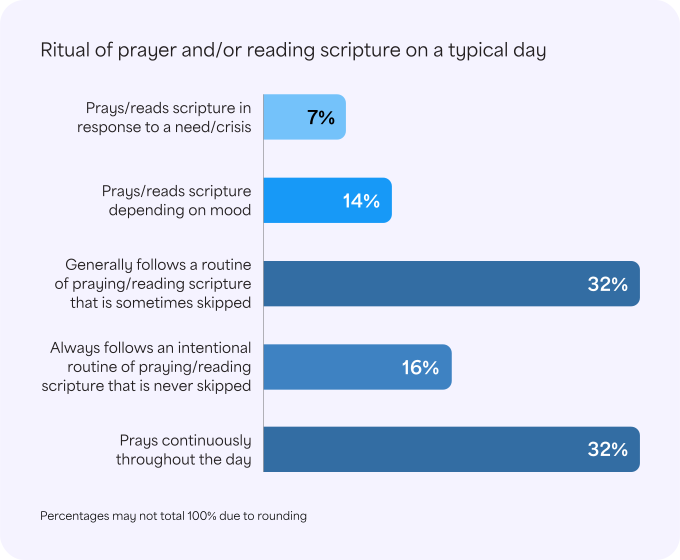
Most faith-based donors also regularly engage in personal religious practices: 80% of Christian donors report praying continuously throughout the day or following a prayer or scripture reading routine.
Chart showing 80% of faith-based donors pray continuously or follow a daily prayer or scripture reading routine.
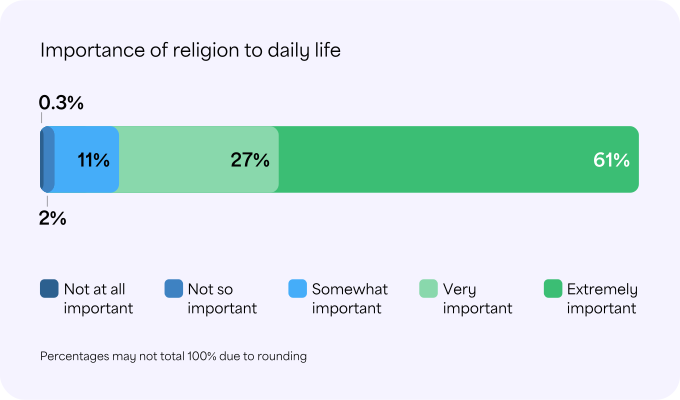
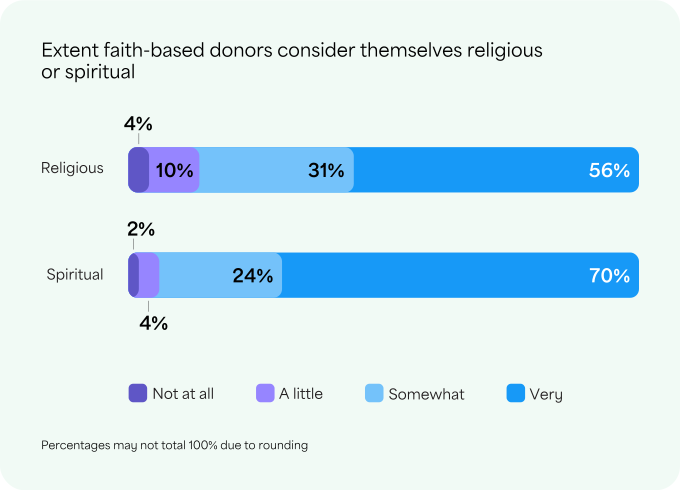
Finally, the Christian donors surveyed were likely to identify as religious and spiritual people. A majority (88%) of faith-based donors consider religion to be very or extremely important to their daily life. Similarly, most (70%) faith-based donors consider themselves very spiritual, while only 14% say they are not very religious.
Chart showing 88% of faith-based donors consider religion very or extremely important to their daily life.
Chart showing 70% of faith-based donors identify as very spiritual and 14% as not very religious.