Menu

Close

Chapter 7 • 2026 GIVING IN FAITH REPORT
Technology and Consistent Giving
Technology can support generosity habits, but lasting giving is shaped by deeper motivations. This chapter explores how faith leaders can use digital tools to better support consistent generosity and donor engagement.
Smiling female church donor with curly hair using a digital giving tool on her mobile phone while seated indoors on a couch.Smiling female church donor with curly hair using a digital giving tool on her mobile phone while seated indoors on a couch.Smiling female church donor with curly hair using a digital giving tool on her mobile phone while seated indoors on a couch.

Key takeaways

  • Although donors hold mixed views on tech, habit-forming mobile apps grounded in faith can improve giving consistency.
  • Recurring giving works best for donors who already have strong giving habits and financial stability.
  • Technology cannot replace intentional generosity for donors still developing consistent giving habits.

How this applies to faith leaders

  • Evaluate where your digital giving tools help different donors stay engaged in their generosity journey.
  • Offer recurring giving as one option while recognizing that most donors value intentional giving and other giving pathways.
  • Include a mobile giving app specifically designed for faith communities to help sustain generosity habits over time.
Having introduced the Consistent Giving Model in Chapter 6, this chapter examines how technology influences consistent giving habits in practice. It also builds on earlier findings about faith-based donor profiles and provides further insight into how consistent givers engage with digital giving tools and how they differ from other donors in their use of recurring giving.
Drawing on a real-world field experiment, along with an analysis of automatic recurring giving, this chapter examines how digital tools can support the process of developing more consistent giving habits over time. Together, these findings clarify what technology can and cannot do to help donors move toward greater consistency in their giving.

Church leaders and donors view technology differently

During the COVID-19 pandemic, church leaders rapidly adopted digital tools to maintain connections with their congregations while in-person services were suspended.[79], [80] Church leaders experienced firsthand the benefits of digital giving tools and other technologies in supporting their congregations.
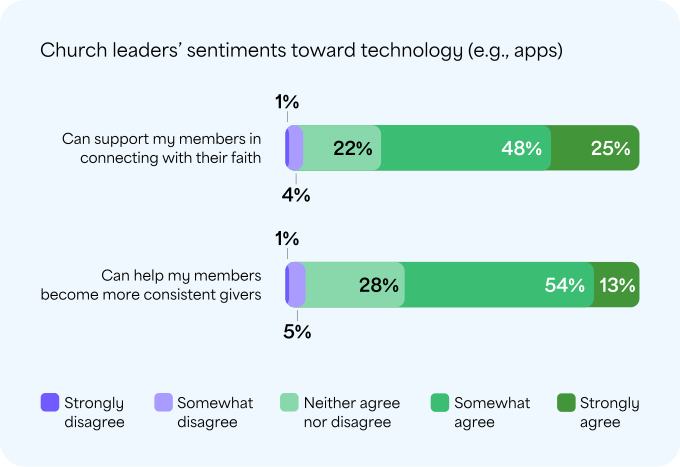
These experiences appear to shape how church leaders view technology today: 73% agree that technological tools can support members in connecting with their faith. Additionally, 67% of church leaders agree that technological tools can help their church members become consistent givers, similar to what was reported in 2023 (72%).[2]
Church technology: chart showing 67% of church leaders agree digital tools can support members in becoming consistent givers.
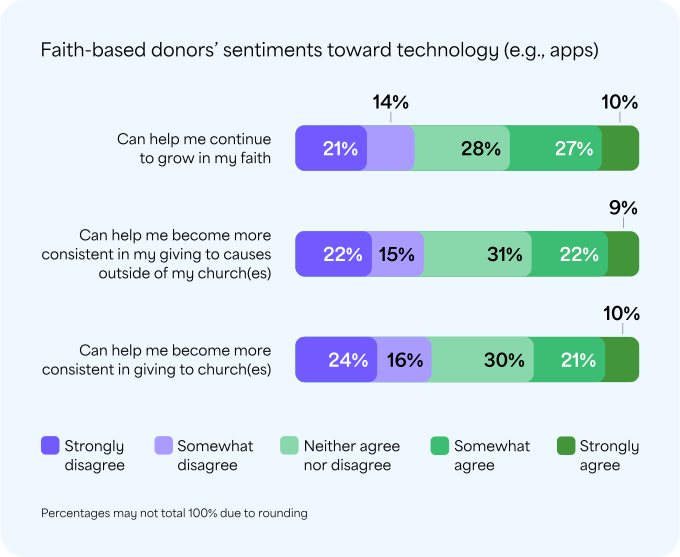
In contrast, faith-based donors are more skeptical about the role of technological tools in supporting their giving or their connection to faith. Only 31% agree that these tools can support them in becoming consistent (or more consistent) givers, either to their church or to causes outside of it. Additionally, only 37% agree that technological tools can support them in connecting with their faith.
Church technology: chart showing only 31% of donors agree digital giving tools can help them become consistent givers.
Skepticism about technology is even more pronounced when the conversation turns to artificial intelligence (AI) for both church leaders and faith-based donors. In 2023, church leaders reported limited enthusiasm for AI tools in their congregation, and most had never used them. Other reports have shown that few churches have adopted AI tools,[81] though the proportion of churches now using AI tools to assist with operational responsibilities has increased in recent years.[82], [83]
Recent articles also point to growing concern about certain applications of AI, such as AI-generated pastors, which raise fears that church leaders could be replaced.[84] These concerns are further amplified by the rise in AI-enabled fraud, including deepfakes that impersonate pastors.[85]
Survey results indicate that negative perceptions of AI persist among both church leaders and faith-based donors. Currently, only 35% of church leaders agree that AI-powered tools can support their members in connecting with their faith, and 29% agree that AI tools can support them in becoming consistent givers.
Church technology: chart showing only 29% of church leaders agree AI-powered tools can support consistent giving.
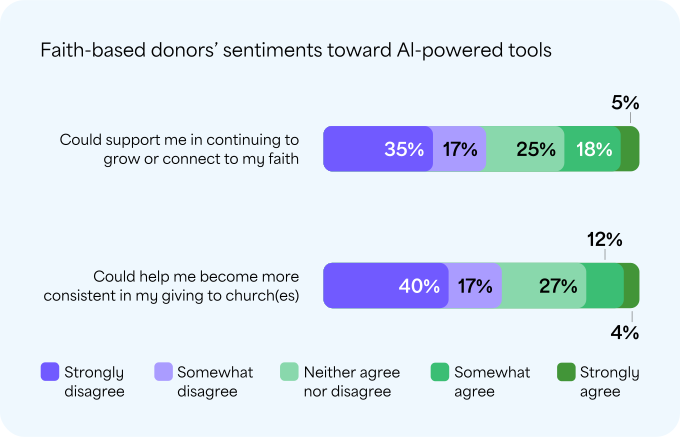
Likewise, only 16% of faith-based donors agree that AI-powered tools can support them in becoming consistent givers, and only 23% agree that AI tools can support them in connecting with their faith.
These perceptions suggest that any AI-powered tools designed to support giving will likely face a significant trust barrier, particularly among donors, and that transparency into how they work may be essential to their adoption.
Church technology: chart showing only 16% of donors agree AI-powered tools can support them in becoming consistent givers.

Digital giving tools can reinforce consistent giving

Despite mixed views on technology’s role in giving, field experiments using features within the Givelify mobile giving app show that donors who engage with specific digital tools can meaningfully increase both their frequency and total amount of donations.
These features, collectively known as Givelify’s Champions of Good program, leverage several of the external motivators identified in our Consistent Giving Model to support the development of giving habits. For example, one component recognizes donors for their generosity each time they make a gift. As discussed earlier, research shows that donor appreciation increases the likelihood of giving again in the future.[72], [86] Moreover, positive feelings, induced by both the act of giving (i.e., warm glow) and receiving recognition,[86] promote future prosocial behaviors.[87]
Another component awards badges to donors for reaching different tiers of giving. These badges recognize generosity while also signaling social comparison and status, particularly as higher tiers become more exclusive. This may be especially motivating for donors who are influenced by social prestige, which has been shown to increase generosity in certain contexts.[66], [88]
To support donors in reaching their giving goals, Champions of Good also includes features that allow donors to track and reflect on their giving over time. These tools implicitly provide them with an external benchmark by using the prior year’s giving as an anchor. For donors with a giving goal already in mind, this feature helps them see their progress. Studies find that people are more motivated to perform a desired action as they get closer to reaching that goal, a phenomenon known as the “goal-gradient effect.”[65], [89] This effect has also been observed in prosocial behaviors: People are more likely to give when they are closer to reaching a fundraising goal (i.e., a progress bar showing they are 85% to the goal), likely due to greater feelings of impact and personal satisfaction.[90] These tracking features leverage that effect to motivate donors to reach their giving goals.
Research further shows that reflecting on one’s past actions, including prior generous acts,[77] and even the intention to engage in generous behaviors,[91] can induce feelings of gratitude. Gratitude is not only associated with increased hope and happiness,[92] but it has also been positively linked to prosocial behaviors.[93] Thus, features that enable donors to reflect on their past generosity may stimulate feelings of gratitude and reinforce future giving behavior.
Finally, to support consistent giving, donors who give through Givelify can also track their consistent giving with monthly streaks. Research has shown that gamification features such as streaks can motivate positive behaviors and build habits in other contexts, such as learning[94] or physical fitness.[95] Streaks can help reinforce behavior through loss aversion: the tendency to avoid losing something of value.[96] They also make abstract goals, such as giving consistently every month, more concrete and actionable. This structure can help some people achieve their goals.[95] While prior research has not specifically tested streaks in donation behavior, these mechanisms suggest they may support habit formation. Taken together, these features are designed to help donors set and reach goals, reflect on their generosity, and maintain a pattern of monthly consistency.
While the underlying mechanisms of Champions of Good are grounded in behavioral science and could, in theory, support donors in building giving habits, we designed and conducted a field experiment to empirically test whether these features influenced giving outcomes in practice. Specifically, the experiment compared giving outcomes between donors who used Champions of Good and those who did not. We hypothesized that donors who engaged with these features would make more donations.

Field experiment: Testing real-world giving behavior

In January 2023, the Champions of Good program was launched within the Givelify mobile giving app and made available to all donors who give to places of worship or nonprofit organizations through the platform. However, access to the program and its features was enabled only for donors who had made at least three donations that year.
A one-year field experiment was conducted in 2023 to compare giving outcomes between donors who used Champions of Good and those who did not. The analysis was conducted in early 2024 using behavioral data from 2022 and 2023.
The Test group (N=21,775) consisted primarily of faith-based donors who had Champions of Good enabled, used the feature, and had donation data from 2022. The Control group (N=21,775) consisted primarily of faith-based donors who also had Champions of Good enabled but did not use the feature.
Additional details on the study design, including how the groups were constructed and the statistical methods used, are provided in the Methodology section.

Donors who used Champions of Good gave more generously

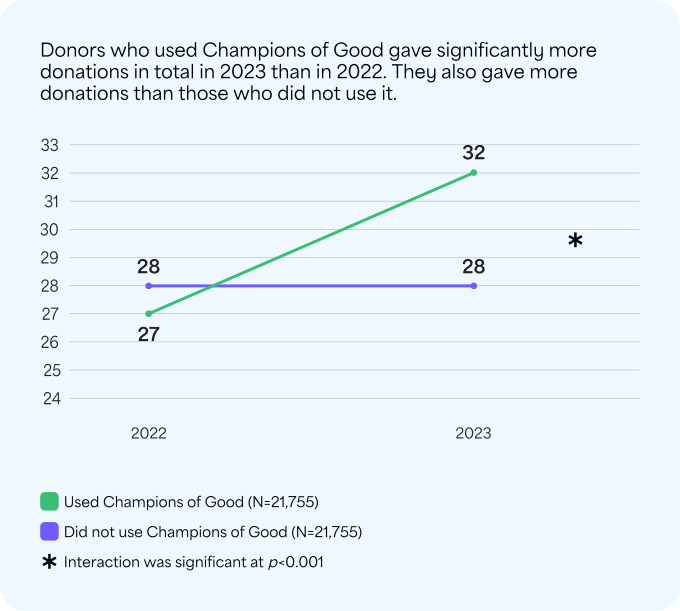
It was hypothesized that Champions of Good would increase donor generosity by encouraging more frequent giving. While the Test and Control groups gave a similar (not statistically significantly different) number of gifts in 2022, only the Test group increased the number of gifts given in 2023 after using the features.
Digital giving tools: Champions of Good users significantly increased number of gifts in 2023 vs. 2022 control group.
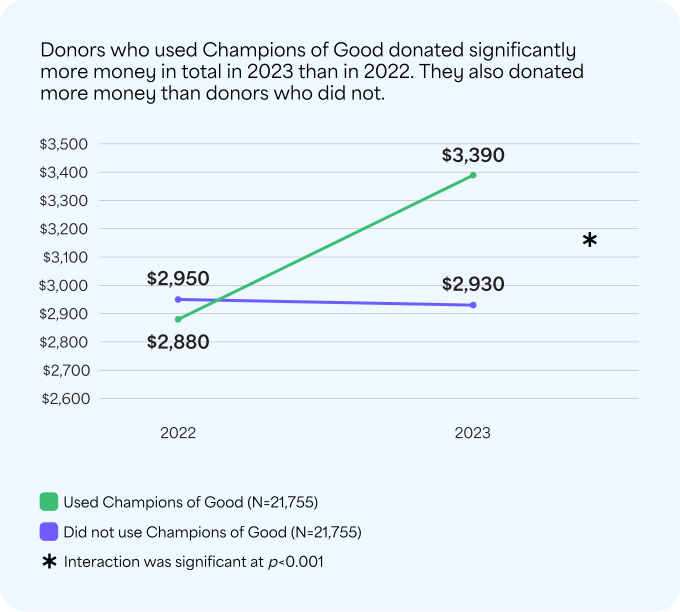
In general, the number of donations that people make is positively correlated with the total amount given. Thus, it was also hypothesized that donors who used Champions of Good would give more in total after using the feature. Although both groups gave a similar (not statistically significantly different) total dollar amount in 2022, only the Test group increased the total amount given in 2023.
Digital giving tools: Champions of Good users gave significantly more in total dollars in 2023 vs. the control group.

Donors who tracked their giving gave more often

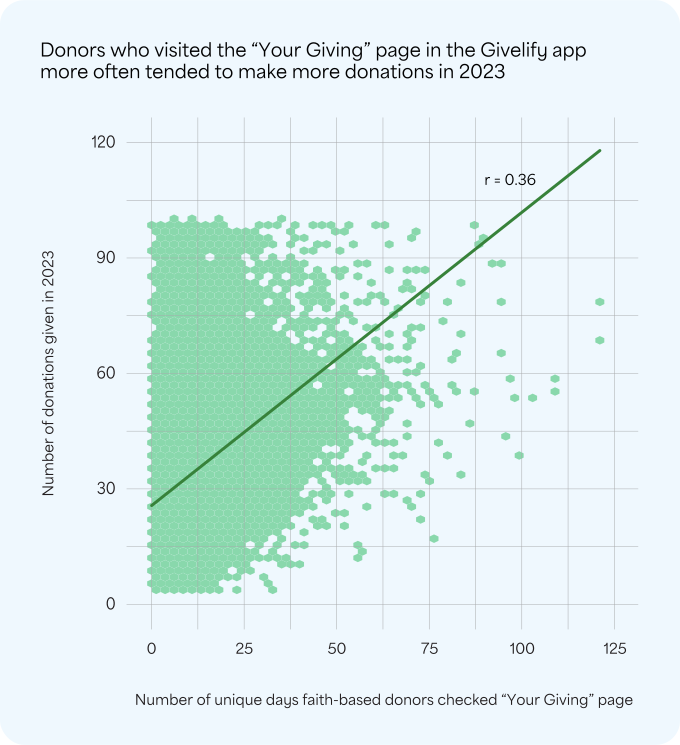
We also examined whether donors who used Champions of Good more often were also more likely to give. Donors who visited the “Your Giving” page — the area in the Givelify app where donors can track their giving progress — more often also made more donations, with a statistically significant positive correlation (r=0.36).
This relationship suggests that donors who actively track or reflect on their generosity are more likely to give more frequently, although this finding reflects correlation rather than causation.
Digital giving tools: chart showing donors who tracked giving progress (r=0.36) were more likely to give more frequently.

Digital tools can support donors’ consistency

Despite mixed views about technology's role in giving, this field experiment provides evidence for increased frequency and total amount given when donors used Givelify’s Champions of Good.
Specifically, features designed to leverage behavioral motivators, such as loss aversion and the goal-gradient effect, were associated with increases in both giving frequency and total contributions. Furthermore, donors who used these features more often also tended to give more frequently.
These findings suggest that thoughtfully designed digital tools can play a meaningful role in helping donors translate intention into consistent giving behavior.

Recurring giving does not define consistency

Most faith-based donors do not use recurring giving

Recurring giving — the option to have donations automatically withdrawn from a bank account or charged to a credit card on a set schedule — is often treated as a straightforward solution to consistent giving. However, evidence suggests that it is not a universal path to consistency. Using survey responses and analyses of Givelify platform data, this section shows that automatic recurring giving, while effective, works best for a subset of donors. Specifically, it appears most valuable for donors with strong intrinsic motivation, existing consistency, and stable financial situations. For donors who have not yet developed these foundations, recurring giving is unlikely to close the intention-action gap on its own.
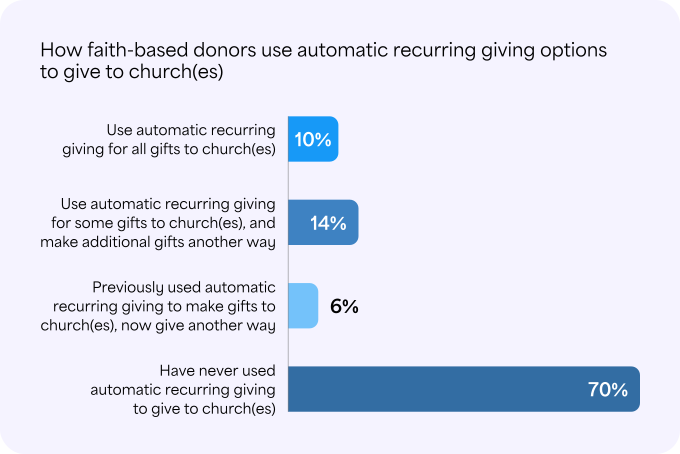
Industry reports and giving guides frequently recommend recurring giving as a primary mechanism for building consistency among donors.[27], [28] Despite these recommendations, adoption among faith-based donors remains low. Most (76%) do not use automatic recurring giving options to give to their churches, consistent with industry benchmarks showing adoption rates between 19% and 23%.[27],[28]
Recurring giving: chart showing 76% of faith-based donors do not use automatic recurring giving to give to their churches.
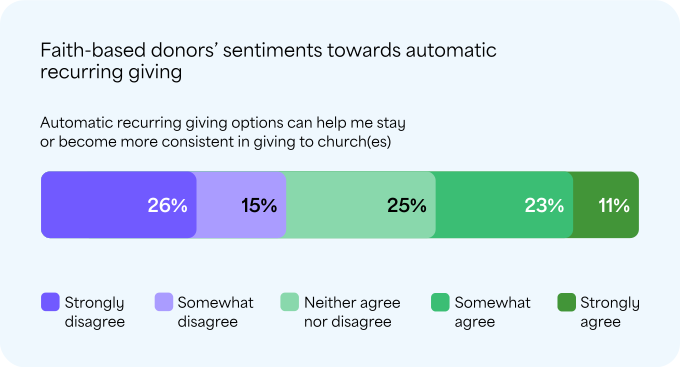
Furthermore, most (66%) faith-based donors do not agree that recurring giving will help them become more consistent givers.
Recurring giving: chart showing 66% of donors do not agree recurring giving will help them become more consistent givers.

Recurring giving reduces friction, but does not build intention

To understand why recurring giving is not a sufficient solution for all donors, it is helpful to return to the Consistent Giving Model introduced in Chapter 6. In this model, a habit of giving is formed and sustained through the repeated activation of all three phases: Opportunity, Intention, and Action.
Recurring giving reduces exposure to repeated giving appeals and automates the Action phase. Once recurring giving is activated, subsequent gifts occur automatically. For faith-based donors who have already developed strong internal motivations to give, automation could make practicing generosity more convenient. But for donors who have not yet developed these intrinsic motivations, automation bypasses the very process through which those motivations grow. Additionally, consciously choosing to engage in generosity is associated with the psychological and emotional benefits of giving. Self-determination research finds that donors who freely choose to engage in prosocial behaviors experience greater satisfaction and wellbeing effects than those not given a choice.[53]
Thus, donors who never consciously choose to give are unlikely to develop the kind of meaningful relationship with generosity that makes giving self-sustaining.
This distinction matters because consistent giving is not only a behavioral outcome; it is also an expression of faith. Indeed, donors most commonly reported that they want their giving to be intentional (44%) as the primary reason why they do not use recurring giving. Furthermore, only 17% of consistent givers report that recurring giving is a tool that they use to help them stay consistent in their giving (Chapter 6). That practice is not well served by removing the active decision-making about giving from their hands.
Recurring giving: chart 
showing that most faith-based donors (44%) don’t use recurring giving because they want their giving to be intentional.

Recurring giving is most common among already-consistent donors

To examine who adopts recurring giving and what distinguishes those who continue using it, this report draws on three complementary analyses. The first matches survey respondents to their Givelify platform data to compare observed, not just self-reported, recurring giving use across demographic characteristics, including household income. The second analysis uses Givelify platform data to compare donors who used recurring giving in 2024 with those who never used it, examining their giving patterns during the 12 months prior to adoption as a baseline. The third focuses only on donors who used recurring giving in 2024. It compares the giving behavior of those who continued using recurring giving for at least 12 months with those who eventually canceled it. Full details on the three analyses are available in the Methodology section.
The findings from all three analyses point to a clear pattern: Donors who adopt and maintain recurring giving tend to have greater financial capacity and stronger convictions to stay consistent in their giving.
First, the survey-linked analysis shows that recurring giving was more common among higher-income donors. Respondents with household incomes above $50,000 were more than twice as likely as those with household incomes below $50,000 to have used recurring giving (8.9% vs. 3.9% of donors). Use of recurring giving was highest among respondents reporting household incomes between $100,000 and $150,000 (14% of donors).
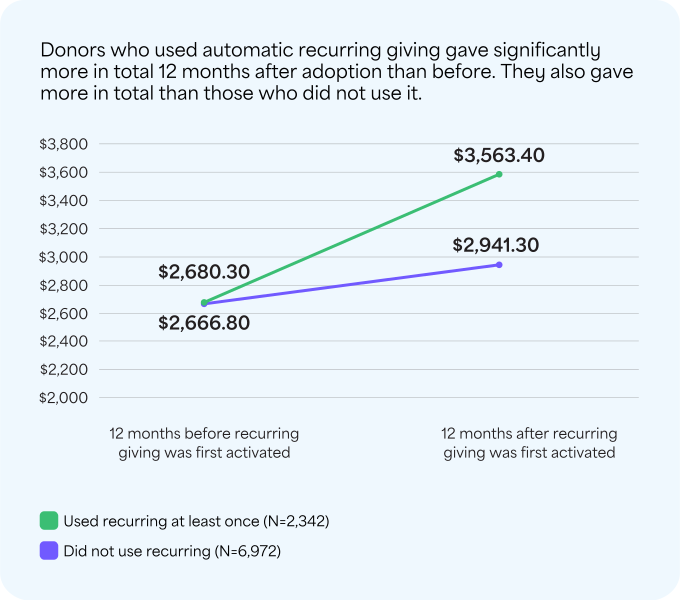
A similar pattern emerges from Givelify platform data: Donors who used recurring giving in 2024 were already giving in more months prior to adoption (median of eight months vs. four months) and giving higher total amounts ($2,680 vs. $1,689).
Chart showing donors who used recurring giving in 2024 were already giving in more months prior to adoption.
These two analyses suggest that recurring giving is more likely to be adopted by donors with more predictable financial circumstances. Indeed, financial considerations are the second most common reason donors report for not using recurring giving. Some donors are uncomfortable with automatic withdrawals from their accounts (21%), while others say their income is not on a predictable pay cycle (16%).
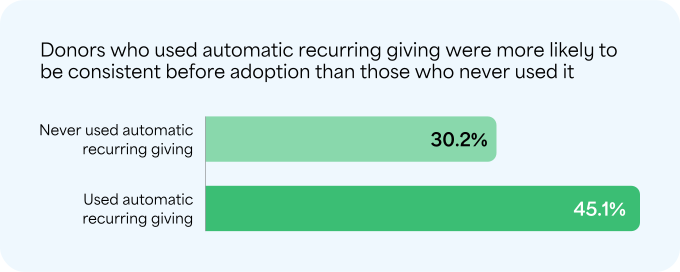
Further examination of Givelify platform data finds that donors who used recurring giving in 2024 were already more consistent before adopting the feature than donors who never used it. That is, they were more likely to qualify as consistent givers at baseline (45.1% vs. 30.2%).
Recurring giving: users were already more likely to be consistent givers before adoption — 45.1% vs. 30.2% for non-users.
This pattern persists among donors who continued to use recurring giving for longer durations. Those who maintained recurring giving for at least 12 months were more consistent and gave more in total at baseline than those who eventually canceled it. These findings suggest that donors with stronger giving habits and greater financial capacity are not only more likely to try recurring giving, but they are also more likely to continue using it.
In other words, donors who adopt and continue to use recurring giving are typically those who have already built a foundation of consistent giving, and the tool helps them maintain it. They are also more likely to be in financial situations that allow them to absorb potential variability or risk.

Recurring giving helps committed givers become more consistent

For donors who are already giving consistently and have stable financial situations, recurring giving offers real benefits: It helps them maintain a commitment to financial stewardship (48%), enables them to give with intention (26%), and reduces the friction of remembering to give (12%). These motivations describe donors who have already made a considered decision to give at a certain level and want a tool to support that decision reliably. Their giving behavior on Givelify further demonstrates how recurring giving helps them give with purpose: Three in four donors who use recurring giving on Givelify still make intentional, non-recurring gifts.
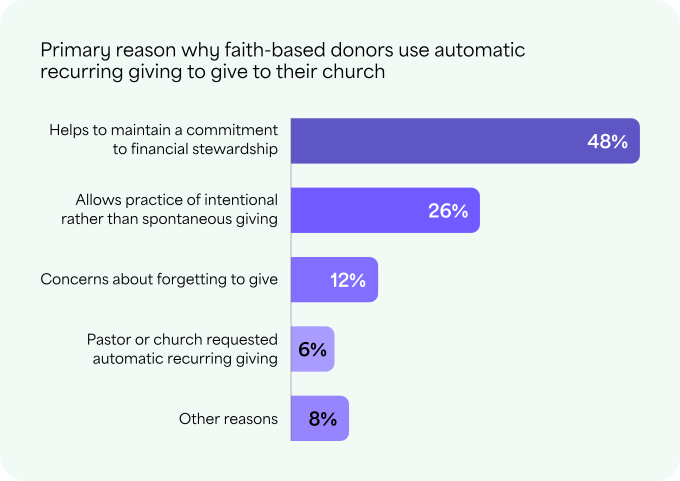
Recurring giving: chart showing top reasons for use are financial stewardship (48%) and enabling intentional giving (26%).
Moreover, for this subset of donors, recurring giving helps them maintain their habit of giving. The data show that its use is associated with meaningful improvements in consistency, frequency, and giving amount. Faith-based donors who used recurring giving made substantially more donations (+12.4 vs. +0.9) and gave more in total (+$973 vs. +$105) in the 12 months after adoption than a similar matched cohort of donors who did not use recurring giving.
Recurring giving: continuous users gave +$973 more in total in the 12 months after adoption vs. +$105 for non-users.
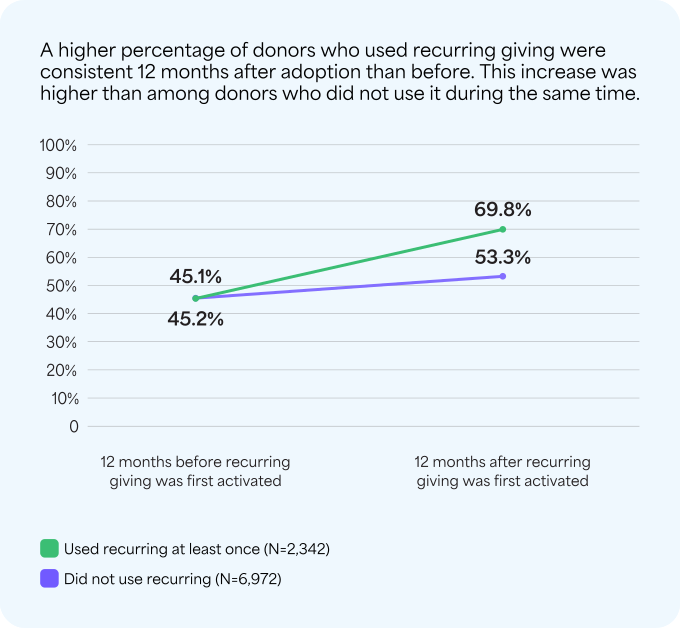
Recurring giving was also associated with improved consistency among donors who used it. Twelve months after first using recurring giving, 70% of donors who used it qualified as consistent donors, up from 45% prior to its adoption. The increase in the share qualifying as consistent donors was smaller among those who did not use recurring giving: 45% to 53% in the same 12-month period.
Recurring giving: consistency rose from 45% to 70% among continuous users vs. 45% to 53% for non-users after adoption.
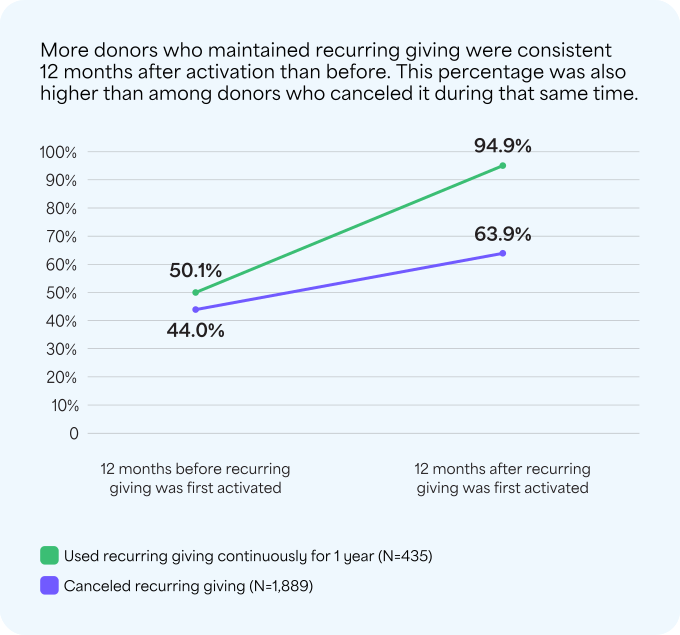
Recurring giving appears to strengthen an existing habit more reliably when it supports a strong intent to give consistently and faithfully. This pattern holds when examining who continues to use recurring giving over time. Among donors who used recurring giving, those who continued using it had higher baseline consistency than those who eventually canceled it (50.1% vs. 44.0%).
Chart showing that faith-based donors who maintain recurring giving already have a high intent to give.
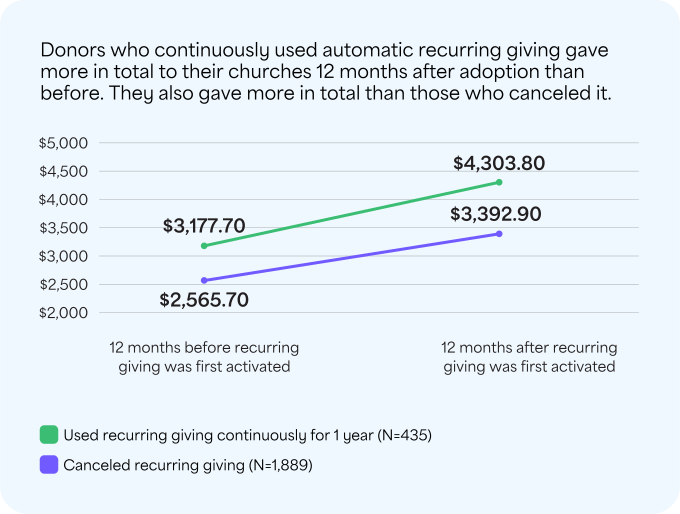
Donors who continued to use recurring giving also had higher prior giving amounts ($3,178 vs. $2,566) and gave in more months after adoption (11.5 vs. 9.0).
Chart showing faith-based donors who continued to use recurring giving also had higher prior giving amounts ($3,178 vs. $2,566).
Sustained use of recurring giving appears more common among donors who enter with higher baseline consistency, stronger convictions to give consistently, and greater giving capacity. This pattern aligns with the Consistent Giving Model's prediction that automatic recurring giving works best when it supports an existing habit of giving or a strong commitment to giving consistently, rather than being used as a broad solution to create consistency.

Technology can reinforce consistency, but not create it

The findings in this chapter tell a consistent story: Technology works best when it reinforces existing motivations, not when it attempts to substitute for them.
Champions of Good demonstrates this principle directly. Digital tools designed to recognize generosity, support goals, and invite reflection on past giving produced meaningful increases in both giving frequency and total contributions. These features worked not because they automated giving, but because they engaged the motivations the Consistent Giving Model identifies as central to habit formation. Donors who interacted with these features more frequently also gave more often, suggesting that the practice of reflection itself may reinforce giving over time.
Recurring giving tells a complementary story. For donors with strong internal motivations to give consistently and who have stable financial situations, recurring giving is a valuable tool for maintaining and deepening their habit. The data confirm this: Donors who maintained recurring giving saw meaningful gains in consistency, frequency, and total giving in the year following adoption. These donors use recurring giving because it supports a commitment they have already made.
However, recurring giving appears unlikely to build that commitment from the ground up, and the data suggest it is insufficient to close the intention-action gap on its own. Donors with financial constraints or who hold a theological commitment to intentional giving are less likely to adopt recurring giving. For these donors, conscious and repeated engagement in the process of Opportunity, Intention, and Action described by the Consistent Giving Model may represent a more promising path toward developing and sustaining consistency.
The studies in this chapter suggest that consistent giving can be meaningfully supported by tools that make the experience of giving more intentional, more visible, and more connected to donors’ aspirations. Understanding which digital tools are most effective for different donors is essential for church leaders seeking to unlock the full potential of their congregations’ generosity.