Consistent giving requires an operational definition
Multiple definitions are not inherently problematic, but they signal that the field has yet to establish a shared, measurable standard. Without such a standard, it is difficult to compare findings across studies, [29] set meaningful benchmarks, or enable donors to track their progress. An operational definition addresses this gap by providing a common framework for researchers, churches, donors, and practitioners to understand consistent giving. Ultimately, a shared definition allows the field to build on prior work and advance the study of faith-based generosity.
Developing a definition of consistent giving
In developing a novel operational definition of consistent giving, we evaluated candidate definitions against several criteria, including clarity and intuitiveness, alignment with the perspectives of church leaders and donors, applicability across Christian contexts, ability to capture commonly observed giving patterns, and practicality for measurement. To inform this evaluation, we drew on existing literature, Givelify’s transactional data, and the behaviors and expectations reported by church leaders and faith-based donors in the 2026 survey.
The first criterion for a consistent giving definition is that it must be understandable and intuitive to a broad audience. As the philanthropic space is multidisciplinary and involves agents of many diverse backgrounds, a definition that is too niche would not serve this community well.
Second, the definition should reflect what is most widely accepted or agreed upon by those it directly affects: church leaders and faith-based donors. Relatedly, the definition must also be broadly applicable to all Christian congregations. It is therefore designed to capture most forms of church giving, while also accounting for denominational and individual differences, such as pay cycles and personal faith practices. These two criteria ensure that the definition of consistent giving is meaningful to the individuals and organizations it impacts (i.e., churches and their members).
An operational definition also requires that the concept be described and measured by the most commonly observed or self-reported behaviors.[29] Thus, the consistent giving definition should be broad enough to include the pattern of giving that is practiced most often among faith-based donors, but precise enough to draw meaningful and measurable distinctions between consistent and inconsistent giving.
Finally, it is necessary to consider the practical applications of the proposed consistent giving definition and the feasibility of its measurement. For example, can faith leaders use this definition to evaluate the efficacy of their spiritual teaching and generosity practices? Can church financial officers apply it to assess the state of consistent giving within their congregations? And can faith-based donors use it as a benchmark or to set goals for their own giving?
Given these criteria, a measurement of consistency by frequency, specifically monetary contributions that occur one or more times within a month, emerged as the strongest candidate for an operational definition of consistent giving. This definition provides a common foundation for researchers and practitioners to study and discuss consistent giving.
Frequency emerged as the clearest definition of consistent giving
Consistency, measured by frequency of giving, emerged as the best candidate for an operational definition. This frequency-based approach is further supported by survey respondents, as it was the most commonly cited method among both church leaders and faith-based donors. Specifically, 38% of church leaders and 49% of donors report that consistent giving is defined by frequency of giving.
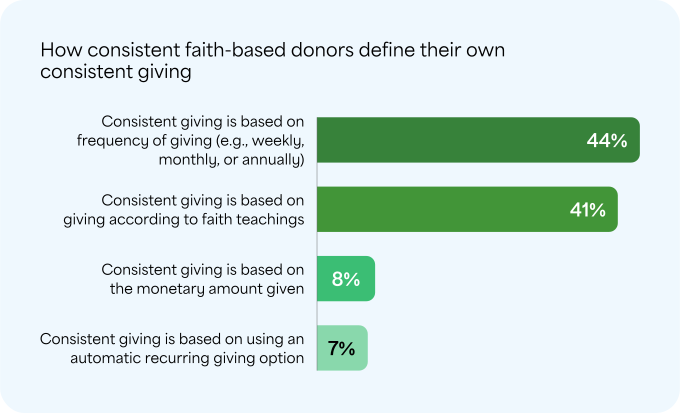
Moreover, consistent givers most often define their giving in terms of frequency (44%). We therefore define consistent giving in terms of frequency.
Tithing-based definition is less universal
Giving in accordance with faith teachings was the second most common definition of consistent giving, selected by 36% of church leaders and 44% of faith-based donors. However, definitions based on faith teachings are less universal than a definition based on giving frequency.
In this context, giving according to faith teachings is understood as adherence to the biblical principle of tithing, the practice of giving 10% of one’s earnings to God.[30] Not all Christian denominations emphasize tithing, and some studies show that while most Protestant churchgoers in the U.S. view tithing as a biblical command, this belief is not universal.[31]
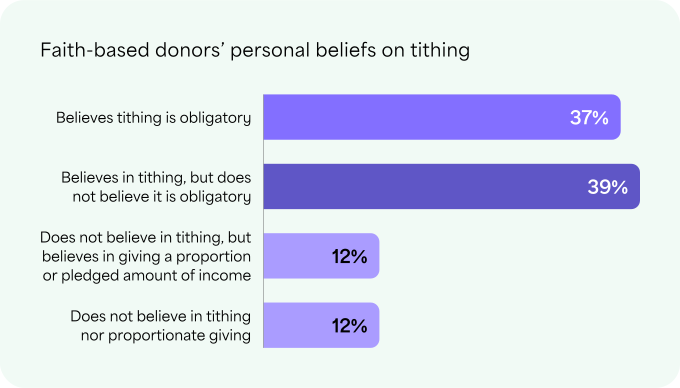
Within this report’s sample, one-third of congregations (33%) do not emphasize that tithing is obligatory. Among donors, only 46% report that their church emphasizes tithing as obligatory, and fewer (37%) personally believe tithing is obligatory.
Because tithing practices vary across denominations, a tithing-based definition of consistent giving could not be universally applicable. In addition, the tithing definition may not be practical or feasible to use. Researchers and church leaders may have difficulty determining whether faith-based donors are tithing in accordance with biblical principles without access to their congregants' income data — information that many congregants may be unwilling to share.
By contrast, giving frequency is more easily quantified by measuring each donor’s pattern of giving over time.
Tithing is often tied to income frequency
According to the biblical principle of tithing, individuals are expected to give 10% of their income. Because most income is earned on a regular schedule, tithing is often practiced with similar frequency.
As of 2023, the U.S. Bureau of Labor Statistics estimates that only 10.2% of working Americans rely on contingent or alternative work (“gig work”) as their primary source of income.[32] Most others get paid at least once a month.[33] Thus, a faith-based donor who routinely tithes when they get paid would also be considered consistent in their giving when using a frequency-based definition.
Consistent with this pattern, only 15% of church leaders whose congregations emphasize tithing do not believe there should be any specific tithing frequency. Most indicate that tithing should occur when donors are paid (27%) or at least once a month (58%).
Consistent giving should occur at least once a month
We propose that consistent giving is defined by a frequency of giving that occurs at least once a month. A monthly cadence is the most inclusive, as it encompasses more frequent giving (e.g., daily, weekly, biweekly) while also including donors who are paid monthly, such as those on a fixed income (who tend to be the most consistent givers), and who therefore give regularly on this cadence.
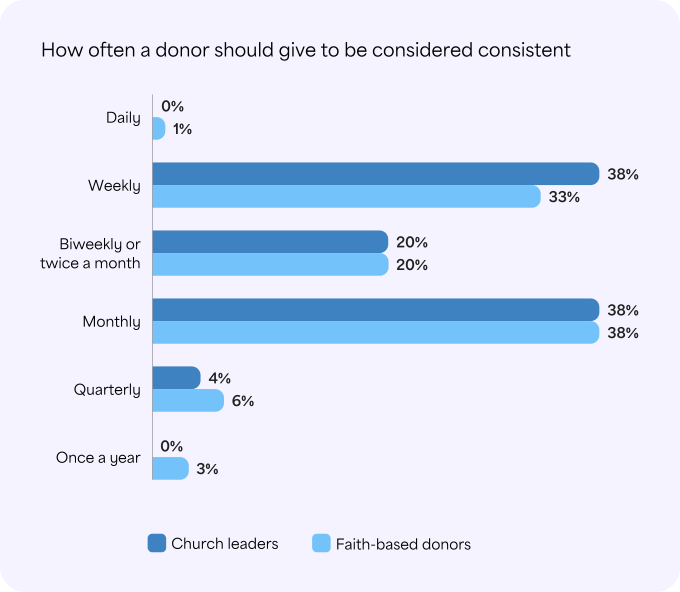
Monthly frequency is also widely favored by congregations and donors. Almost all church leaders (96%) and faith-based donors (91%) who support a frequency-based definition believe that donors should give at least once a month to be considered consistent.
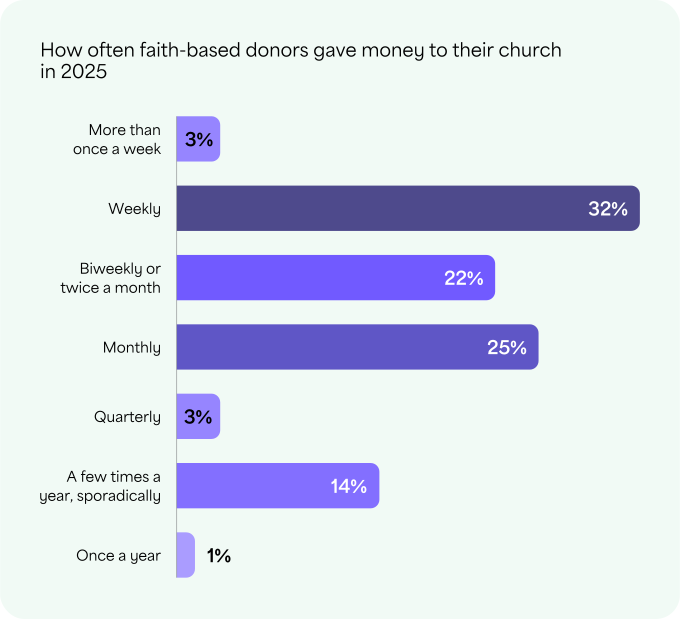
Finally, monthly frequency aligns with the most common giving cadence reported by faith-based donors. Most donors (82%), including those who tithe, already give to their church at least once per month. Among those who identify as consistent givers, nearly all (93%) report giving to their church(es) at least once a month.
While individual faith-based donors may give on schedules they consider consistent, defining consistency based on each person's unique cadence would be impractical to measure. This makes it harder for congregations to compare giving across donors or track progress over time. A single, shared threshold — giving at least once a month — provides both inclusivity and measurability.
Consistent giving allows for variation in giving patterns
We further define consistent giving as giving once per month for most months, specifically, at least 75% of the months in which a faith-based donor could give. For example, a donor who gives at least once a month for nine of twelve months in a year qualifies as a consistent giver under this definition.
Even the most consistent givers may be unable to give every month for a variety of reasons, including unexpected expenses (such as medical bills or emergency home repairs) or logistical constraints (such as travel).
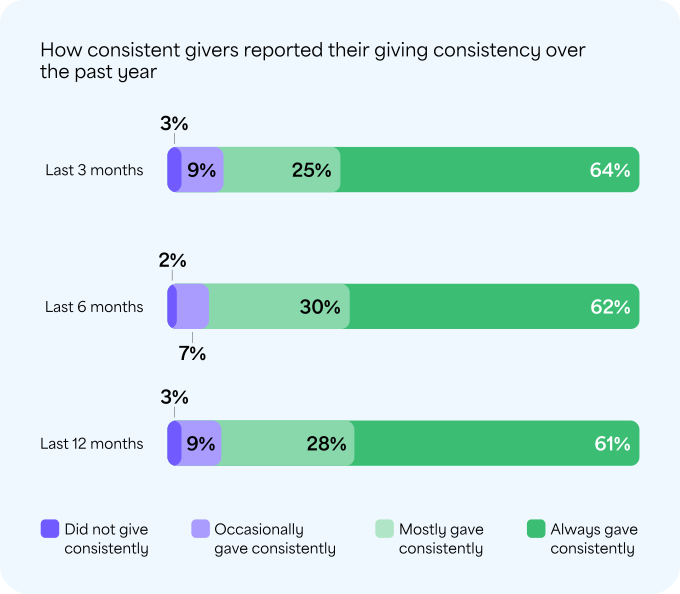
This level of flexibility also reflects observed giving behavior. That is, many donors who identify as consistent report occasional gaps: Only about two-thirds of consistent givers say that they have always given consistently over the past year, six months, and three months.
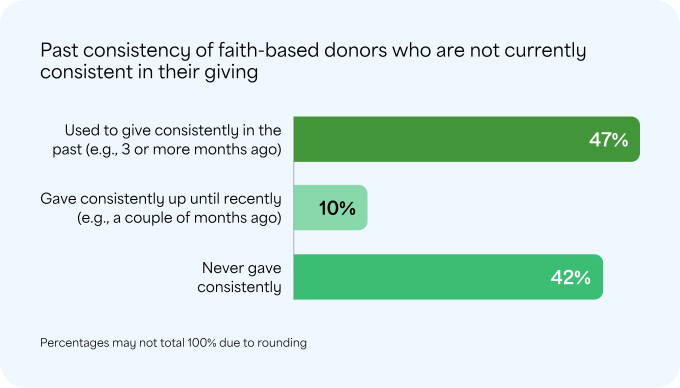
Moreover, even faith-based donors who are not currently consistent givers were likely to report that they considered themselves consistent givers in the past (57%).
Consistent giving includes all regular monetary giving
Consistent giving encompasses all monetary contributions made regularly to churches, including tithes, offerings, or other categories of gifts. Church leaders and faith-based donors generally support this approach.
Church leaders are evenly split between defining consistent giving as regular monetary contributions (46%) and as all regular monetary and non-monetary contributions (46%). Among faith-based donors, most (62%) consider both regular monetary and non-monetary giving to qualify as consistent giving.
As discussed earlier, not all congregations emphasize tithing. A definition that includes only tithing is therefore not universally applicable to Christian giving.
Church leaders and faith-based donors show limited support for restricting consistent giving to tithes alone. Fewer than 10% believe that only regular tithing should count toward consistent giving.
Even among the small proportion of respondents who define consistent giving based on the amount given, only about one-third believe that tithing is required to be considered consistent.
Additionally, a tithe-only definition of consistent giving fails to capture the full range of ways donors express their generosity. As noted in Chapter 2, faith-based donors demonstrate generosity beyond monetary giving, including volunteering their time or donating items.
At the same time, including all forms of non-monetary giving would be difficult to define and measure. First, there is no definitive list of behaviors that constitute acts of generosity. Second, many of these behaviors are difficult to quantify, particularly when they occur frequently or informally.
Therefore, from a feasibility standpoint, a practical operational definition of consistent giving should focus on regular monetary giving.
Recurring giving is not the same as consistent giving
Recurring giving is often defined broadly as giving that occurs repeatedly or at regular intervals. However, in the faith-based context, “recurring giving” more commonly refers to a specific method of giving — setting up automated, recurring payments to a church.
Many reports suggest that recurring giving is equivalent to consistent giving, but a definition based solely on a giving method would be too narrow. Under a recurring giving definition, faith-based donors who give to their church at least once per month using a non-recurring giving method (e.g., cash, check, a giving app) would not be considered consistent.
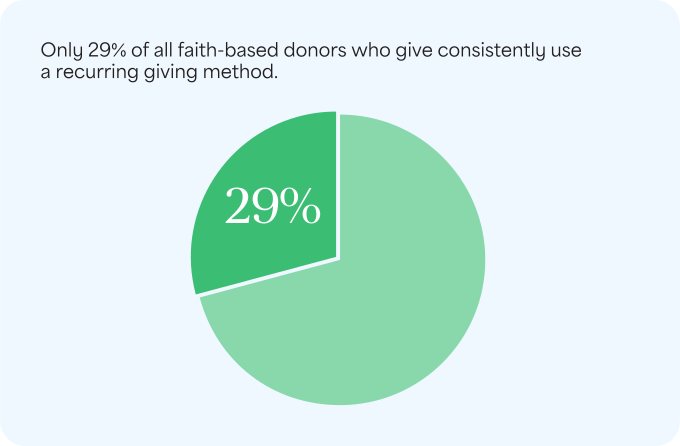
Using this approach, only 29% of faith-based donors who report that their giving is consistent would qualify as consistent givers. In other words, a recurring giving definition excludes the majority of donors who give intentionally and regularly through other means.



.png)




.svg)