Menu

Close

Chapter 8 • 2026 GIVING IN FAITH REPORT
Conclusion: What the 2026 Giving in Faith Report Reveals
This chapter reflects on the report's key findings, what they reveal about generosity and consistent giving, and how faith leaders can strengthen ministry now and in the future.
A church congregation worshipping together, representing the church donors represented in the 2026 Giving in Faith report.A church congregation worshipping together, representing the church donors represented in the 2026 Giving in Faith report.A church congregation worshipping together, representing the church donors represented in the 2026 Giving in Faith report.

Key takeaways

  • Even modest improvements in giving consistency could strengthen churches and grow generosity across faith communities.
  • This research establishes a shared framework for defining, measuring, and understanding consistent giving and what helps sustain it over time.
  • For faith-based donors, generosity often reflects spiritual practice, purpose, and personal conviction.

How this applies to faith leaders

  • Prioritize consistent giving as a long-term strategy to strengthen your church’s impact, serve your community, and plan confidently for the future.
  • Use a shared framework to better measure consistent giving, understand donor behavior, and uncover opportunities to strengthen generosity within your congregation more effectively.
  • Approach generosity as a spiritual practice — not just a financial outcome — to help your members connect giving to faith, purpose, and spiritual growth.
The 2026 Giving in Faith report examines one of the most significant and underexplored challenges facing faith communities today: the consistency shortfall — the gap between donors’ aspirations to give consistently and their actual giving behavior, compounded by church leaders’ overestimation of consistent giving within their congregations. As explored throughout this report, even modest improvements in giving consistency could translate into billions of additional dollars to support congregations and the communities they serve, while deepening the spiritual and psychological fulfillment of faith-based donors.
To better understand this gap, the report addresses a key limitation at the intersection of research and practice: the absence of a shared, measurable definition of consistent giving and a limited understanding of the faith-based donors who practice it. Building on this foundation, the report examines the motivations, behaviors, and aspirations of donors with a depth not previously explored in the literature.
This chapter synthesizes the report’s key findings and explores their implications for church leaders seeking practical guidance, faith-based donors aspiring to grow in generosity, researchers building on the study of faith-based philanthropy, and the broader field working to understand and strengthen generosity in American religious life.

The state of church and faith-based giving in 2025

Despite a turbulent U.S. economy, faith-based giving remained resilient in 2025. Most church leaders reported that their congregations were spiritually and financially healthy, with giving either increasing or remaining stable between 2024 and 2025. At the same time, faith-based donors gave across a wide range of causes and organizations, including churches, registered nonprofits, individuals in need, and informal community organizations. Christian donors also supported their churches by volunteering their time and talents, a reminder that generosity in faith communities extends well beyond the offering plate.
Faith-based giving also continued its technological shift. Almost all churches now offer digital giving options, and these methods account for a meaningful share of total annual contributions. As in-person worship rebounded beyond pre-pandemic levels, generosity increased across both digital and traditional methods. Despite economic uncertainty, these findings suggest that congregations remain important centers of generosity and community support, with consistent giving playing a meaningful role in sustaining their outreach and impact.

Defining consistent giving: A new standard

The central contribution of this report is an operational definition of consistent giving grounded in data, aligned with the expectations of church leaders and faith-based donors, and designed to be applicable across Christian congregations. We propose that consistent giving be defined as a pattern of regular monetary giving that occurs at least once a month for most months. Under this definition, daily, weekly, biweekly, or monthly giving cadences would all qualify as consistent. In practice, a consistent giver is someone who gives one or more times a month in at least nine of 12 months, or three of the preceding four months, when measured over a shorter period.
This definition was selected because it reflects the most common understanding of consistent giving among church leaders and donors, accommodates a range of giving frequencies without excluding monthly givers, recognizes that even the most committed donors may occasionally miss a month, and can be measured using giving data that most churches and giving platforms already collect. It also recognizes that consistent giving is defined by behavior rather than method. Recurring giving, while a useful tool for some donors, is not synonymous with consistent giving. Defining consistency by a specific giving method would exclude many donors who give intentionally and regularly through other means.
A shared definition matters because, without it, churches cannot benchmark their congregations, donors have no clear standard to aspire toward, and researchers cannot compare findings. The definition proposed in this report provides a foundation for churches, researchers, and the broader field to build on, refine, and apply.

The consistency shortfall: Perception vs. reality

Applying this definition to two full years of giving data on the Givelify platform reveals a picture that is both encouraging and sobering.
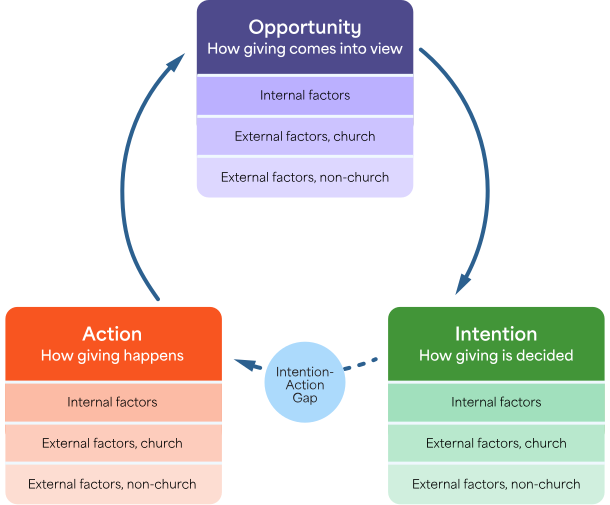
Consistent givers are the financial backbone of their congregations, accounting for more than 81% of the total amount given. Yet they represent only a minority of faith-based donors. While most donors aspire to give more consistently, they struggle to translate those intentions into a sustained giving habit, a phenomenon known as the intention-action gap.
The findings also reveal a significant disconnect between reality and church leaders’ perceptions of consistent giving. When asked to estimate what percentage of their congregation give consistently, church leaders reported an average of 53%, nearly double the observed rate of 27.4%. The perception gap may carry important implications, as overestimating consistent giving could result in missed opportunities to support donors in building more consistent giving habits.
Together, the intention-action gap and the church leader perception gap form what the report identifies as the consistency shortfall. The report estimates that this shortfall represents a potential financial impact of $25 to $30 billion annually across the religious charitable sector, including an estimated $50,000 in additional annual income for a typical congregation.

Introducing faith-based donor profiles

Faith-based donors are not a monolith, and this report identifies four distinct profiles, each defined by a unique combination of giving behaviors, motivations, and aspirations.
The Devoted Giver gives consistently and aspires to give even more. They are the most religiously engaged donors in the study, the most likely to frame giving as an expression of faith, and the most likely to trust their church and believe their giving is making a difference.
The Steady Giver also gives consistently but is satisfied with their current level of generosity and does not aspire to give more. While Steady Givers tithe more than the Awakening Givers, they are less likely to believe that giving is tied to spiritual growth. They also tend to be among the most educated and highest-income donors in the study.
The Awakening Giver aspires to give consistently but has not yet reached that level of frequency. Compared to Devoted and Steady Givers, Awakening Givers are more likely to give most of their gifts in the form of offerings or non-tithes. Financial barriers are the most commonly cited obstacle to consistency, as these donors tend to be younger, have less stable employment, and report lower household incomes than Devoted or Steady Givers.
The Unengaged Giver neither gives consistently nor aspires to do so yet. They score lowest on religiosity, trust in their church, and feelings of fulfillment when they give. While the sample is too small to draw statistically significant conclusions, their patterns are distinct enough to warrant further study.
These donor profiles matter because they suggest that church leaders must adopt different strategies to cultivate and sustain consistent giving across segments. A single discipleship or engagement approach is unlikely to serve Devoted, Steady, Awakening, and Unengaged Givers equally well.

The Consistent Giving Model: How giving habits are formed

Understanding who consistent givers are raises a related question: How do faith-based donors develop consistent giving habits in the first place? To answer this, we propose the Consistent Giving Model, a behavioral framework that maps the stages through which giving habits form and the motivational factors that influence each stage. Building on existing models of behavioral change and charitable giving, the framework divides the giving process into three phases: Opportunity, Intention, and Action.
Each phase is shaped by a combination of external and internal motivators. External motivators may occur within or outside the church context, while internal motivators are rooted more deeply in a donor’s faith identity and personal values. Across all phases, internal motivators tend to be more influential and durable than external ones. External motivators can encourage initial giving and support donors in the early stages of habit formation, but as motivations become more internalized, less external reinforcement is needed to sustain consistent giving.
For church leaders, this framework offers a practical lens for understanding their role in cultivating generosity. Teaching about generosity, modeling giving behavior, sharing the impact of contributions, and expressing gratitude to donors are not peripheral activities. They are part of the conditions through which donors experience the spiritual, emotional, and psychological rewards associated with the formation and maintenance of consistent giving habits.

Technology and consistent giving

The final question explored in this report addresses whether technology can support the habit-building process outlined in the Consistent Giving Model. The findings suggest that, when thoughtfully designed, digital tools can help reinforce consistent giving behaviors.
A field experiment conducted with faith-based donors on the Givelify platform found that donors who used a set of digital features, collectively known as the Champions of Good program, increased both the frequency and total amount of their giving relative to a matched group of donors who did not use these features. The features were designed to leverage behavioral science principles, including donor recognition, goal-gradient effects, reflection on past giving, and streak-based accountability. The findings suggest these principles can positively influence giving behaviors within faith-based contexts as well.
The report also distinguishes recurring giving from consistent giving, two concepts that are often conflated. Most donors do not use recurring giving, whether because of financial constraints or personal beliefs about the spiritual practice of giving. According to the Consistent Giving Model, developing a giving habit requires active and intentional engagement in the giving process, which may be reduced when giving is automated. At the same time, the findings indicate recurring giving is beneficial for donors who already give consistently, have high intent to continue giving consistently, and have the financial stability to automate their giving.
These findings suggest that technology supports consistent giving most effectively when it meets donors where they are in their giving journey and reinforces, rather than replaces, the intentional generosity many faith-based donors describe as central to their faith.

Looking ahead

Recent data suggest spirituality among church attendees has been strengthening,[14],[15] while younger generations are showing renewed interest in spirituality.[21], [22], [23] Church leaders in our survey echoed this optimism.
Faith-based donors share this forward-looking outlook. Most expect to give the same or more to their church in the coming year, and most aspire to extend their generosity to nonprofits, community organizations, and individuals in need. Sixty percent report a strong desire to increase their charitable giving in the next year.
The gap between aspiring to give consistently and actually doing so remains significant for many donors. However, it is a gap that research, practice, and thoughtfully designed tools can help close. This report advances that effort by establishing a shared definition of consistent giving, measuring its prevalence, understanding the donors who practice it, and mapping the conditions under which giving habits form and are sustained.
One of the clearest findings in this report is that generosity is not simply a behavior for faith-based donors. It is an intentional practice that strengthens spirituality, supports their psychological wellbeing, and connects donors to missions larger than themselves. More practically, generosity also sustains the social good provided by faith communities across the country. Understanding faith-based philanthropy within this broader context is essential for cultivating it effectively.